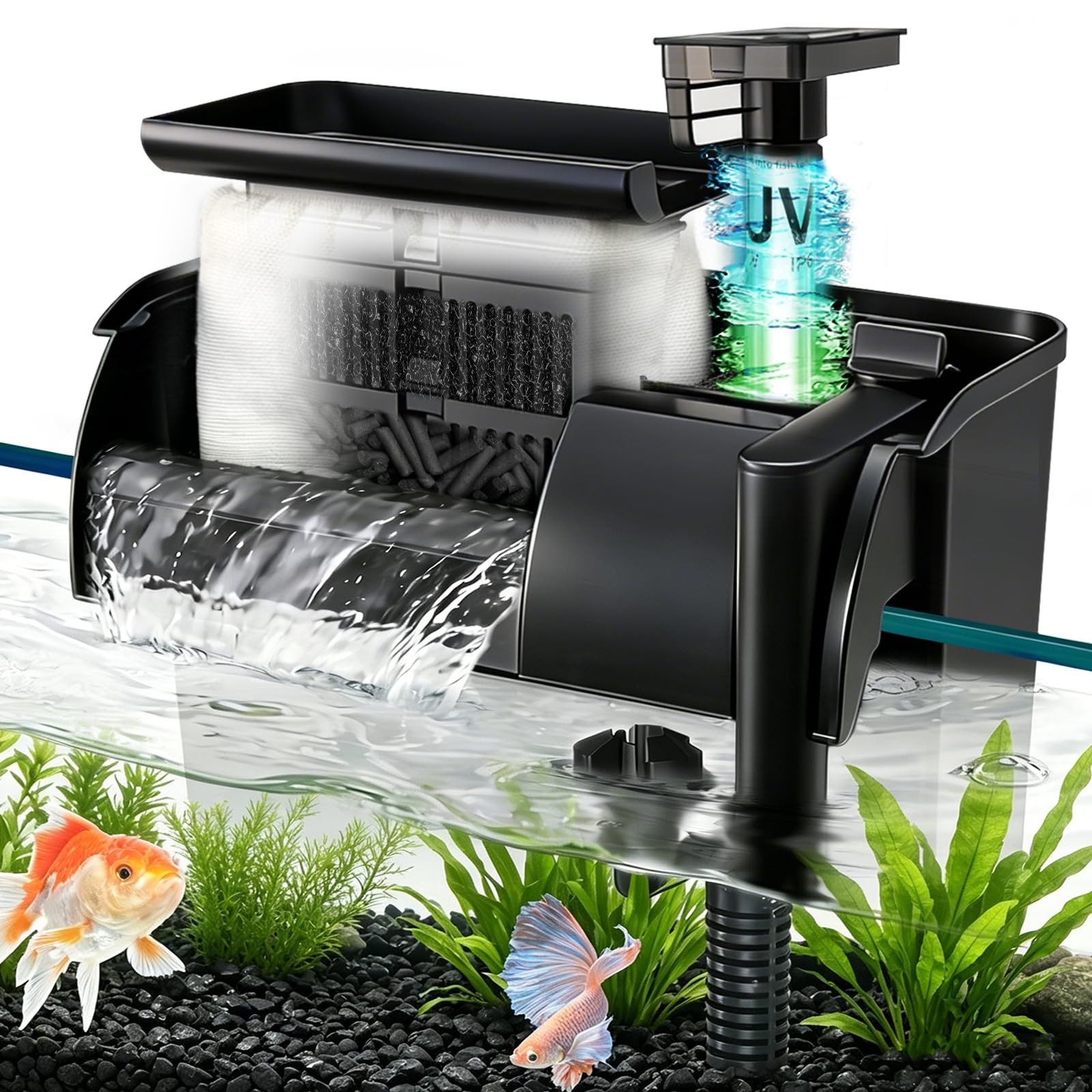

Photos from current listings. Actual item, color, and included accessories may vary.
Aquarium Filter With UV Light Buying Guide
An aquarium filter with UV light combines mechanical/biological filtration with ultraviolet sterilization to clarify water and reduce free-floating algae and pathogens. The key trade-off is UV wattage and contact time versus flow rate: undersized UV chambers or overly fast pumps defeat sterilization, while oversized units add heat and cost. Choose a unit with a matched pump-to-UV ratio and serviceable quartz sleeve; skip open-bulb 'clarifier' lamps that lack a sealed chamber and proper dwell time.
Key takeaways
- UV effectiveness depends on dose (mW·s/cm²): algae control needs ~15–30 mW·s/cm², while parasite sterilization needs 90+ mW·s/cm², so match wattage to flow.
- Sealed quartz-sleeve reactors with turbidity-free pre-filtered water outperform open submerged bulbs that leak UV and foul quickly.
- Integrated canister filters with UV typically run 5–13 W UV on 100–300 GPH flow; separate inline sterilizers use 8–55 W for ponds and large tanks.
At a glance
- Category
- Aquarium Filters & Pumps
- Last updated
- Nov 28, 2026
Current offers
Highlights
- UV effectiveness depends on dose (mW·s/cm²): algae control needs ~15–30 mW·s/cm², while parasite sterilization needs 90+ mW·s/cm², so match wattage to flow.
- Sealed quartz-sleeve reactors with turbidity-free pre-filtered water outperform open submerged bulbs that leak UV and foul quickly.
- Integrated canister filters with UV typically run 5–13 W UV on 100–300 GPH flow; separate inline sterilizers use 8–55 W for ponds and large tanks.
- Replace UV bulbs every 6–12 months; output decays before visible failure, and quartz sleeves must be wiped monthly to maintain transmission.
Best use cases
- Best fit: Planted community tanks with green-water blooms — pick an integrated canister with 5–9 W UV and 100–200 GPH matched to tank volume.
- Best fit: Goldfish/pond setups — choose a separate inline UV sterilizer rated for the actual pond volume and flow, not the lamp's 'up to' gallon claim.
- Wrong fit: Reef/marine tanks relying on UV for disease control — UV reduces free-floating pathogens but does not replace quarantine or ozonation.
- Skip: Open-bulb 'clarifier' lamps in sumps without a housing; they expose livestock and provide insufficient contact time for meaningful sterilization.
Buying tips
- Size UV wattage to flow: aim for 1–3 GPH per UV watt for algae clarification and under 1 GPH per watt for parasite-level dosing.
- Match filter flow to tank turnover: 4–6× tank volume per hour for freshwater community, 8–10× for goldfish/cichlids.
- Prefer units with standard quartz sleeves and commonly available bulb bases (G23/G27) for easy replacement.
- For canister UV combos, confirm the UV chamber is post-mechanical filtration; pre-filtered water keeps the sleeve clean and dose stable.
Specs
| UV Type | Sealed quartz sleeve vs open bulb |
|---|---|
| UV Wattage | 5–13 W nano/canister; 8–55 W pond |
| Flow vs Dose | Algae 1–3 GPH/W; parasite <1 GPH/W |
| Bulb Service Life | 6–12 months; G23/G27 bases |
Related searches
What to check before buying
- Measure tank volume and cabinet space: integrated UV canisters need vertical clearance for hoses and a drip-free seal.
- Confirm voltage/plug standard (120 V US vs 220–240 V export) and that the pump wattage matches your outlet circuit.
- Check hose/tubing inner diameter (typically 1/2", 5/8", or 3/4") matches filter ports and any inline UV reactor.
- Verify replacement bulb and quartz sleeve availability before purchase; odd sizes strand the unit at bulb-change time.
FAQ
Data sources: eBay / Amazon listings and product attribute feeds. Updated Nov 28, 2026.
Some links on this page are affiliate links. If you buy after clicking one, we may earn a commission at no extra cost to you. This does not change which products appear here or their order. Affiliate disclosure.