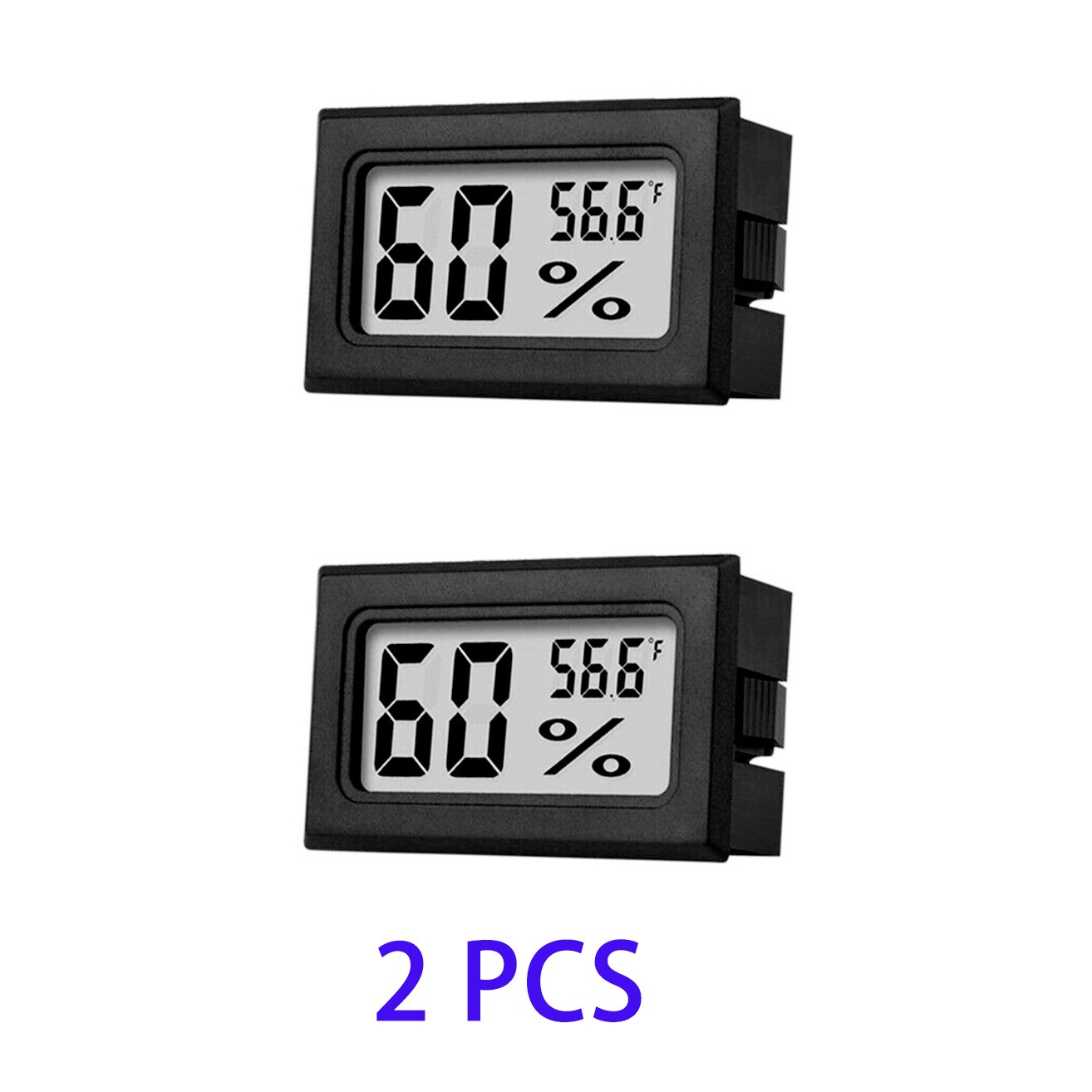

Photos from current listings. Actual item, color, and included accessories may vary.
Hygrometer Thermometer Buying Guide
A hygrometer thermometer for reptiles is a dual-sensor environmental monitor that tracks ambient temperature and relative humidity inside a terrarium, paludarium, or rack system. The core trade-off is between basic LCD units with ±5% RH / ±1.5°C accuracy and calibrated digital sensors with ±2–3% RH accuracy, external probes, and min/max logging. The decision rule: any keeper relying on humidity gradients for shedding, respiratory health, or incubation must skip analog dials and uncalibrated all-in-one pucks in favor of digital units with stated accuracy tolerances and remote probes.
Key takeaways
- Digital LCD units with onboard sensors read ambient air at the device body; accuracy claims of ±5% RH and ±1°C are typical entry-tier, while ±2–3% RH calibrated sensors are the practical threshold for reliable reptile husbandry.
- Probe-style hygrometers separate the sensor from the display, enabling readings at basking spots, hides, and shed boxes without opening the enclosure — critical for maintaining humidity gradients across large terrariums.
- Min/max memory and alert thresholds distinguish monitoring-grade devices from simple gauges; units lacking resetable extremes cannot confirm nighttime humidity spikes or basking-surface temperature drops.
At a glance
- Category
- Reptile Thermostats & Monitoring
- Last updated
- Nov 23, 2026
Current offers
Highlights
- Digital LCD units with onboard sensors read ambient air at the device body; accuracy claims of ±5% RH and ±1°C are typical entry-tier, while ±2–3% RH calibrated sensors are the practical threshold for reliable reptile husbandry.
- Probe-style hygrometers separate the sensor from the display, enabling readings at basking spots, hides, and shed boxes without opening the enclosure — critical for maintaining humidity gradients across large terrariums.
- Min/max memory and alert thresholds distinguish monitoring-grade devices from simple gauges; units lacking resetable extremes cannot confirm nighttime humidity spikes or basking-surface temperature drops.
- Passive analog dial hygrometers rely on a coiled bimetallic or hygroscopic element and drift measurably over months; digital capacitive sensors hold calibration better and are the only sensible choice for tropical and desert species alike.
Best use cases
- Tropical species (crested geckos, dart frogs, chameleons): pick a digital hygrometer with ±3% RH accuracy and min/max logging to track the 60–80% humidity band and nighttime spikes — skip basic puck gauges that cannot confirm a 90%+ nighttime peak.
- Arid species (bearded dragons, leopard geckos, uromastyx): choose a probe thermometer-hygrometer combo to read basking surface and cool-hide humidity separately — skip single-body LCD units that report only one air pocket.
- Bioactive and planted terrariums: select a unit with an external probe and wide RH range (10–99%) that tolerates misting and high humidity without fogging the display — skip vent-mounted analog dials that corrode and fog.
- Rack systems and incubators: use compact digital units with min/max memory per tub or a multi-zone monitor — skip decorative dial hygrometers that read a single point and drift between seasons.
Buying tips
- Match sensor tolerance to species: ±2–3% RH and ±0.5–1°C is the practical tier for humidity-sensitive reptiles; ±5% RH units are acceptable only for hardy, wide-tolerance species.
- Prefer a separate probe over a body-mounted sensor when the enclosure exceeds roughly 60 cm in any dimension — a single-point reading cannot represent the gradient from basking zone to cool hide.
- Check display range: a hygrometer that bottoms out at 20% RH cannot verify desert-species gradients below that, and one capped at 90% RH cannot confirm tropical nighttime spikes.
- Choose capacitive digital sensors over analog dials for longevity; analog hair-element hygrometers drift with dust and mineral buildup and cannot be recalibrated in the field.
Specs
| Sensor Accuracy | ±2–3% RH / ±0.5–1°C (digital) |
|---|---|
| Sensor Type | Capacitive digital vs analog dial |
| Probe vs Onboard | Remote probe / body-mounted |
| Memory Features | Min/max logging + alerts |
Related searches
What to check before buying
- Measure the enclosure's internal height and mounting spots — probe cables typically run 1–2 m; confirm the display can sit outside the tank while the probe reaches the target zone.
- Verify the unit's power source: button-cell (LR44/CR2032) units need tool-free battery doors and last months, while USB-powered monitors require a cord route that does not compromise the lid seal.
- Confirm the display is readable through condensation and at the enclosure's actual temperature range — LCDs can blank below freezing or above roughly 50°C.
- Check whether the hygrometer is rated for high-humidity continuous use (mist systems, foggers) — splash-resistant or remote-probe designs outlast vent-mounted dials.
FAQ
Data sources: eBay / Amazon listings and product attribute feeds. Updated Nov 23, 2026.
Some links on this page are affiliate links. If you buy after clicking one, we may earn a commission at no extra cost to you. This does not change which products appear here or their order. Affiliate disclosure.