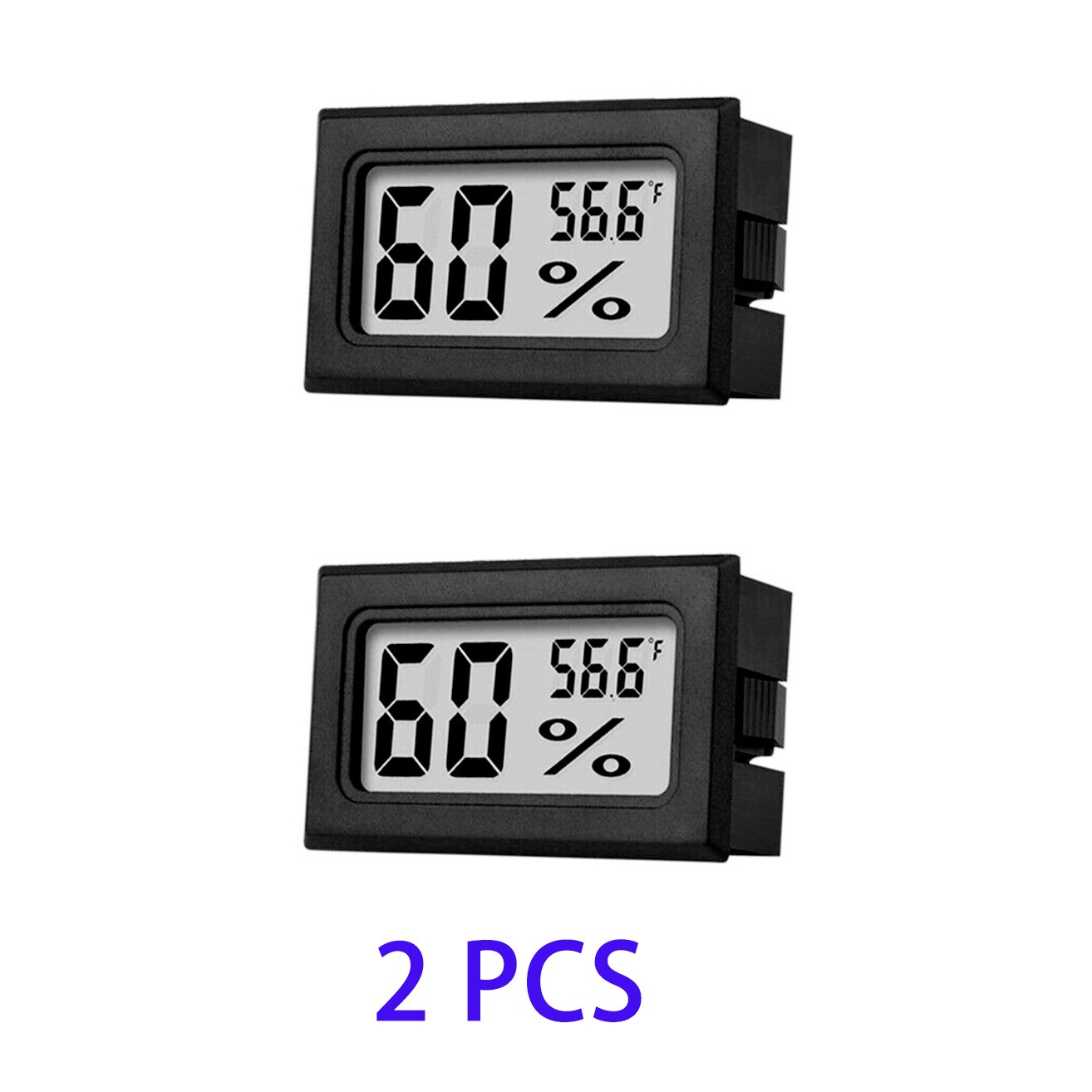

Photos from current listings. Actual item, color, and included accessories may vary.
Digital Hygrometer Thermometer Buying Guide
A digital hygrometer thermometer is a dual-sensor gauge that reports ambient temperature and relative humidity, used to maintain the narrow climate bands reptiles require. The core trade-off is sensor accuracy and calibration stability versus display convenience: cheap resistive humidity sensors drift ±5–10% RH, while capacitive sensors hold ±2–3% RH. Buy a capacitive-sensor unit with a stated accuracy spec; skip any gauge that lists no RH tolerance or cannot be calibrated.
Key takeaways
- Capacitive humidity sensors hold ±2–3% RH accuracy and drift slowly; resistive sensors commonly drift ±5–10% RH within months and cannot be recalibrated.
- Dual-display LCD units update once every 10–30 seconds; slow-update gauges mask basking-spot spikes, so pick a model rated for 10-second or faster refresh.
- Remote-probe models read basking and cool-zone temps simultaneously; in-unit sensors only measure where the gauge sits, forcing you to move it between zones.
At a glance
- Category
- Reptile Thermostats & Monitoring
- Last updated
- Nov 23, 2026
Current offers
Highlights
- Capacitive humidity sensors hold ±2–3% RH accuracy and drift slowly; resistive sensors commonly drift ±5–10% RH within months and cannot be recalibrated.
- Dual-display LCD units update once every 10–30 seconds; slow-update gauges mask basking-spot spikes, so pick a model rated for 10-second or faster refresh.
- Remote-probe models read basking and cool-zone temps simultaneously; in-unit sensors only measure where the gauge sits, forcing you to move it between zones.
- Min/max memory and high/low alarms are the practical difference between a basic gauge and a monitoring unit that catches nighttime drops before the animal is harmed.
Best use cases
- Best fit: arboreal or tropical setups (crested geckos, day geckos, chameleons) — pick a dual-display capacitive unit with min/max memory and 10-second refresh; skip single-reading stick-on dial gauges.
- Best fit: desert setups (bearded dragons, leopard geckos) — choose a unit with a remote probe for the basking spot plus an in-unit RH sensor; skip probe-less gauges that only read the cool end.
- Wrong fit: large paludariums or multi-tank racks — a single cheap gauge cannot cover the gradient; use one calibrated unit per zone or a multi-sensor station instead of one central gauge.
- Wrong fit: high-condensation misting enclosures — unsealed LCD housings fog and fail; pick an IP-rated or probe-separated unit, not a bare board in a vented plastic shell.
Buying tips
- Require a stated RH accuracy of ±3% or better and a temp accuracy of ±1°C/±2°F; unstated tolerances mean ±5–10% RH drift you cannot correct.
- For basking-spot control, choose a remote-probe thermometer rated to at least 60°C/140°F; in-unit sensors mounted on the cool wall will under-read the hot zone by 10–15°C.
- Prefer units with min/max reset and a calibration offset; a salt-test-correctable gauge stays trustworthy for years, a sealed one becomes landfill after one drift cycle.
- Match display size to viewing distance: 2-inch LCDs are readable across a 4-foot enclosure; tiny 1-inch panels force you to open the tank, which dumps humidity.
Specs
| Sensor Type | Capacitive ±2–3% RH vs Resistive ±5–10% |
|---|---|
| Temp Accuracy | ±1°C / ±2°F (probe ±0.5°C) |
| Probe Reach | 1–3 m remote cable |
| Display Features | Min/max memory, alarm, cal offset |
Related searches
What to check before buying
- Measure the mounting zone: probe cables are typically 1–3 m; confirm the probe reaches the basking spot from the display's outside-glass mount.
- Check enclosure humidity range: for 70–90% RH tropical setups, confirm the sensor is rated to 95% RH condensing, not just 80% non-condensing.
- Confirm battery type and count (commonly 1–2 AAA or a CR2032 coin cell); coin-cell units die faster and are harder to swap in a rack.
- Verify the gauge fits your vent or glass-mount footprint — adhesive and suction mounts need a flat 2×2-inch surface clear of misting nozzles.
FAQ
Data sources: eBay / Amazon listings and product attribute feeds. Updated Nov 23, 2026.
Some links on this page are affiliate links. If you buy after clicking one, we may earn a commission at no extra cost to you. This does not change which products appear here or their order. Affiliate disclosure.