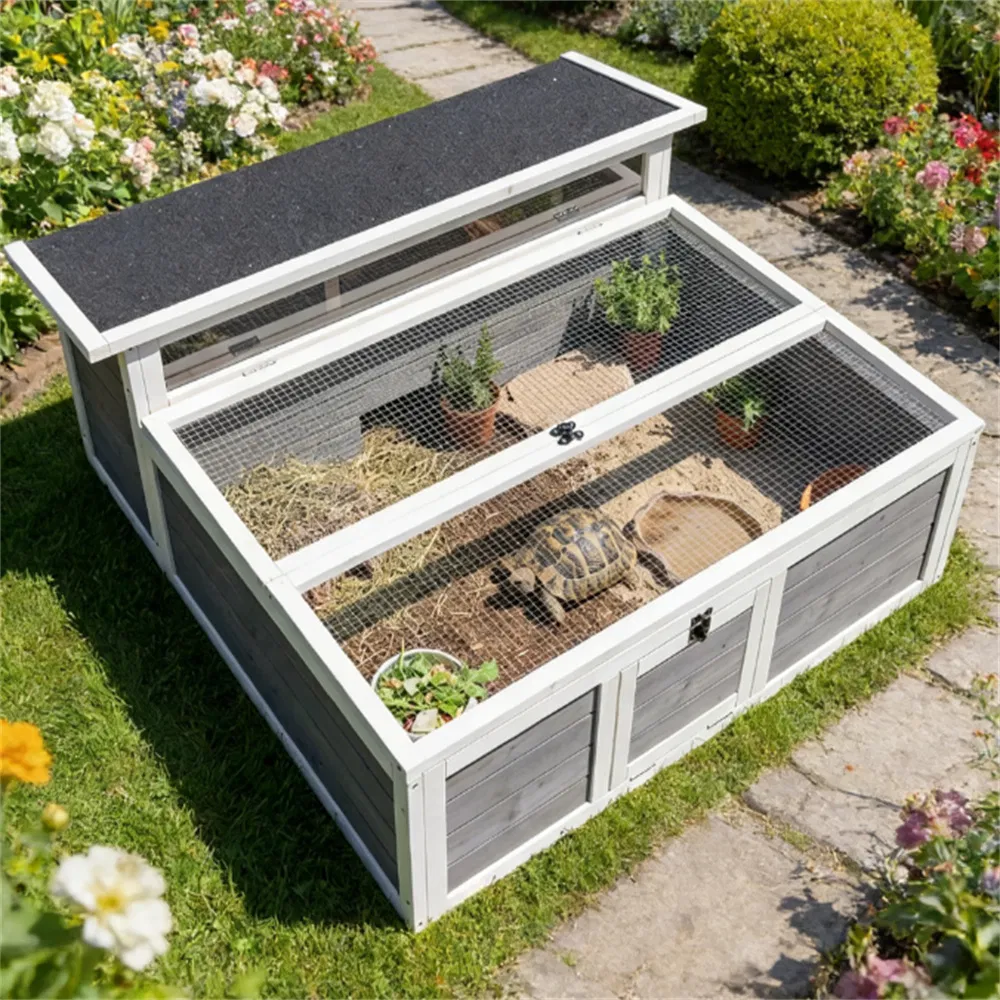

Photos from current listings. Actual item, color, and included accessories may vary.
Turtle Habitat Buying Guide
A turtle habitat is a complete life-support system combining a watertight basin, dry basking zone, UVB/heat lighting, and species-appropriate substrate and hides. The primary trade-off is between open-top tubs/tanks that simplify filtration and temperature control versus enclosed wooden or PVC vivaria that hold humidity but demand sealed liners and ventilation planning. The decision rule: match habitat volume and land-to-water ratio to the adult size and species first, then choose materials that resist water damage for a decade, not a season.
Key takeaways
- Aquatic turtles need roughly 10 gallons of water per inch of shell length; a 4-inch adult requires a 40-gallon water volume minimum, not a 40-gallon tank half-filled.
- Box turtles are terrestrial: they need 4-6 sq ft of damp, diggable substrate at 4-6 inches depth and a shallow water dish, not a swimming pool.
- UVB output decays in 6-12 months even when the lamp still glows; T5 HO fluorescent tubes outlast and outpenetrate compact coils over mesh screens.
At a glance
- Category
- Reptile Substrate, Decor & Hides
- Last updated
- Nov 28, 2026
Current offers
Highlights
- Aquatic turtles need roughly 10 gallons of water per inch of shell length; a 4-inch adult requires a 40-gallon water volume minimum, not a 40-gallon tank half-filled.
- Box turtles are terrestrial: they need 4-6 sq ft of damp, diggable substrate at 4-6 inches depth and a shallow water dish, not a swimming pool.
- UVB output decays in 6-12 months even when the lamp still glows; T5 HO fluorescent tubes outlast and outpenetrate compact coils over mesh screens.
- Solid pine or plywood vivaria wick moisture and warp unless the interior is sealed with pond liner or epoxy; PVC sheet and HDPE resist swelling permanently.
Best use cases
- Best fit: eastern box turtle in a 4x2 ft floor-space enclosure with 5 inches of coco coir/playsand mix, a shallow 1-inch water pan, and a screen top for UVB penetration.
- Best fit: red-eared slider or painted turtle in a 75-125 gallon stock tank or aquarium with 10 gallons per inch of shell, a haul-out dock, and a canister filter rated 2-3x the water volume.
- Wrong fit: buying a small 20-gallon starter kit for a species that reaches 8-12 inches; upgrade to the adult footprint immediately or skip the purchase.
- Skip: open wire cages for any turtle; they cannot hold humidity or water and offer no thermal gradient control.
Buying tips
- Size the water volume at 10 gallons per inch of adult shell length (not current size) and choose a canister filter rated for at least twice that volume.
- For wooden or plywood houses, require interior pond-liner or epoxy sealing, stainless or coated fasteners, and a removable floor for cleaning; untreated wood fails within one wet season.
- Choose substrate by species: coco coir/playsand mix at 4-6 inches for box turtles; bare bottom or large river rock for sliders to prevent impaction from gravel.
- Match lighting to the enclosure: T5 HO 5.0-10.0 UVB tube over screen mesh at 12-18 inches; replace tubes every 12 months regardless of visible output.
Specs
| Habitat Type | Aquatic tank vs terrestrial vivarium |
|---|---|
| Water Volume Rule | 10 gal per inch shell length |
| Land Area (Box Turtles) | 4-6 sq ft, 4-6 in substrate |
| UVB Standard | T5 HO 5.0-10.0, 12-18 in, 12-mo swap |
Related searches
What to check before buying
- Measure adult shell length and calculate water volume at 10 gal/inch; confirm the tank or tub footprint fits your floor or stand with 6 inches of clearance above for lighting.
- Verify the enclosure's interior is sealed (pond liner, epoxy, or PVC) and that the floor supports the wet weight of water—8.3 lb per gallon plus substrate.
- Confirm a grounded outlet within cord reach for heater, filter, and UVB; use a drip loop and GFCI protection for all water-adjacent equipment.
- Check ambient room temperature range: aquatic turtles need 75-80°F water and a 90-95°F basking spot; a room below 68°F requires a submersible heater and a stronger basking lamp.
FAQ
Data sources: eBay / Amazon listings and product attribute feeds. Updated Nov 28, 2026.
Some links on this page are affiliate links. If you buy after clicking one, we may earn a commission at no extra cost to you. This does not change which products appear here or their order. Affiliate disclosure.