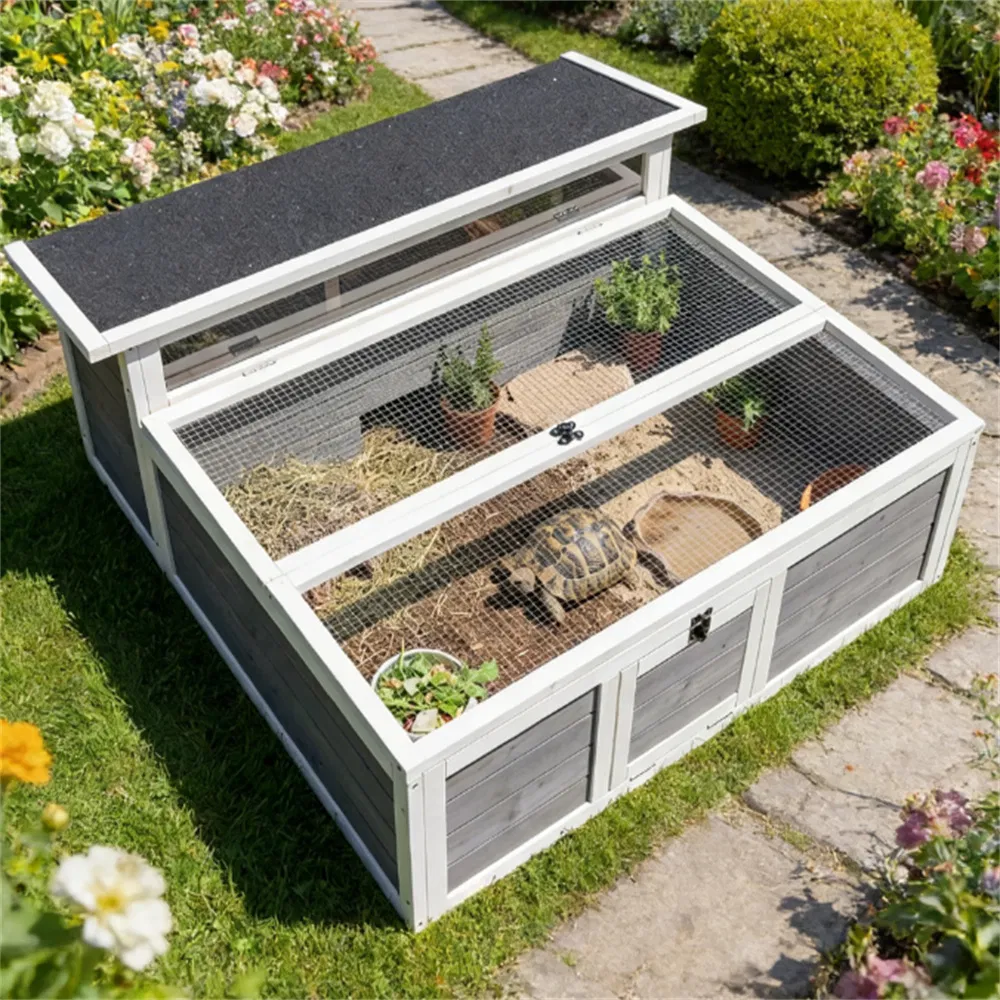

Photos from current listings. Actual item, color, and included accessories may vary.
Turtle Enclosure Buying Guide
A turtle enclosure is a complete life-support system combining a watertight basin, dry basking zone, and species-appropriate substrate and hides. The core trade-off is between open-top tubs or stock tanks (cheap, easy to drain, but visually plain and escape-prone) and wooden or cabinet-style vivariums (insulated, furniture-grade, but heavy and humidity-sensitive). The decision rule: buy the largest footprint your floor plan allows, then match water depth, basking ramp slope, and UVB distance to the adult size of your species—anything smaller than 4x adult shell length is a compromise that forces filtration upgrades and stress-related illness.
Key takeaways
- Open-top stock tanks and tubs in 40–150 gallon tiers give the best volume-per-dollar for juvenile red-eared sliders and painted turtles; wooden cabinet enclosures hide plumbing but need sealed marine-grade plywood or HDPE liners.
- Basking dock slope should sit at 30–45 degrees with a fully dry platform; UVB bulb-to-shell distance must be 10–12 inches for T5 HO tubes and 6–8 inches for compact fluorescents to deliver usable UV index.
- Substrate depth of 4–6 inches of coco coir or topsoil supports burrowing for box turtles and mud turtles; fully aquatic species need bare-bottom or large river pebbles to prevent ingestion and simplify siphon cleaning.
At a glance
- Category
- Reptile Substrate, Decor & Hides
- Last updated
- Nov 28, 2026
Current offers
Highlights
- Open-top stock tanks and tubs in 40–150 gallon tiers give the best volume-per-dollar for juvenile red-eared sliders and painted turtles; wooden cabinet enclosures hide plumbing but need sealed marine-grade plywood or HDPE liners.
- Basking dock slope should sit at 30–45 degrees with a fully dry platform; UVB bulb-to-shell distance must be 10–12 inches for T5 HO tubes and 6–8 inches for compact fluorescents to deliver usable UV index.
- Substrate depth of 4–6 inches of coco coir or topsoil supports burrowing for box turtles and mud turtles; fully aquatic species need bare-bottom or large river pebbles to prevent ingestion and simplify siphon cleaning.
- Filtration flow should turn over the full water volume 3–5 times per hour; canister filters rated for 2x tank volume compensate for the high bioload of turtles compared to fish.
Best use cases
- Best fit: indoor living-room setup for a single adult slider—pick a 75–125 gallon stock tank with a canister filter, external basking dock, and a screen lid; skip wooden cabinets unless the room stays below 60% relative humidity.
- Best fit: hatchling or juvenile quarantine—use a 20–40 gallon tub with shallow water (2–3x shell length), a floating dock, and daily 10-minute natural sunlight or a T5 UVB; skip large permanent enclosures until the shell hardens.
- Best fit: box turtle or tortoise table—choose a 4x2 ft open-top wooden or PVC enclosure with 6 inches of coco coir and a hide; skip aquarium-style glass tanks because side reflections stress terrestrial species and impede airflow.
- Wrong fit: outdoor patio enclosure in freezing climates without a heated hide or stock-tank heater; wrong fit: glass terrarium for a fast-growing slider because front-opening panels leak water and limit depth.
Buying tips
- Enclosure footprint should be at least 4x the adult shell length and 2x the shell width; a 10-inch adult slider needs roughly 40x20 inches of floor space plus a dry dock.
- Water depth for strong swimmers should be 1.5–2x shell length with a ramp they can climb; for weak swimmers or hatchlings keep depth at 1–1.5x shell length and add resting ledges.
- Match the enclosure material to humidity: sealed marine plywood or HDPE for high-humidity tropical species, powder-coated aluminum or PVC for arid tortoise tables, and glass only for fully aquatic display setups with silicone-sealed edges.
- Budget filtration by volume, not tank label: a canister rated for 2x the water volume handles turtle waste; sponge filters alone are insufficient beyond 20 gallons.
Specs
| Enclosure Type | Stock tank / tub / wooden vivarium |
|---|---|
| Water Volume Tier | 40–150 gal (3–5x turnover/hr) |
| Basking Dock Slope | 30–45° with dry platform |
| Substrate Depth | 0 in bare / 4–6 in burrowing |
Related searches
What to check before buying
- Measure floor space and doorway clearance: a 125-gallon stock tank is roughly 6 ft long and will not fit through a standard 30-inch door without tilting.
- Confirm outlet proximity and GFCI protection within 6 ft of the water line for heater, filter, and UVB fixtures.
- Check basking bulb wattage versus lid height: a 100W halogen needs 12–14 inches of clearance to avoid overheating the shell.
- Verify the stand or floor load: a filled 100-gallon tank weighs over 800 lbs; place on a slab or reinforced joists, not a particle-board cabinet.
FAQ
Data sources: eBay / Amazon listings and product attribute feeds. Updated Nov 28, 2026.
Some links on this page are affiliate links. If you buy after clicking one, we may earn a commission at no extra cost to you. This does not change which products appear here or their order. Affiliate disclosure.