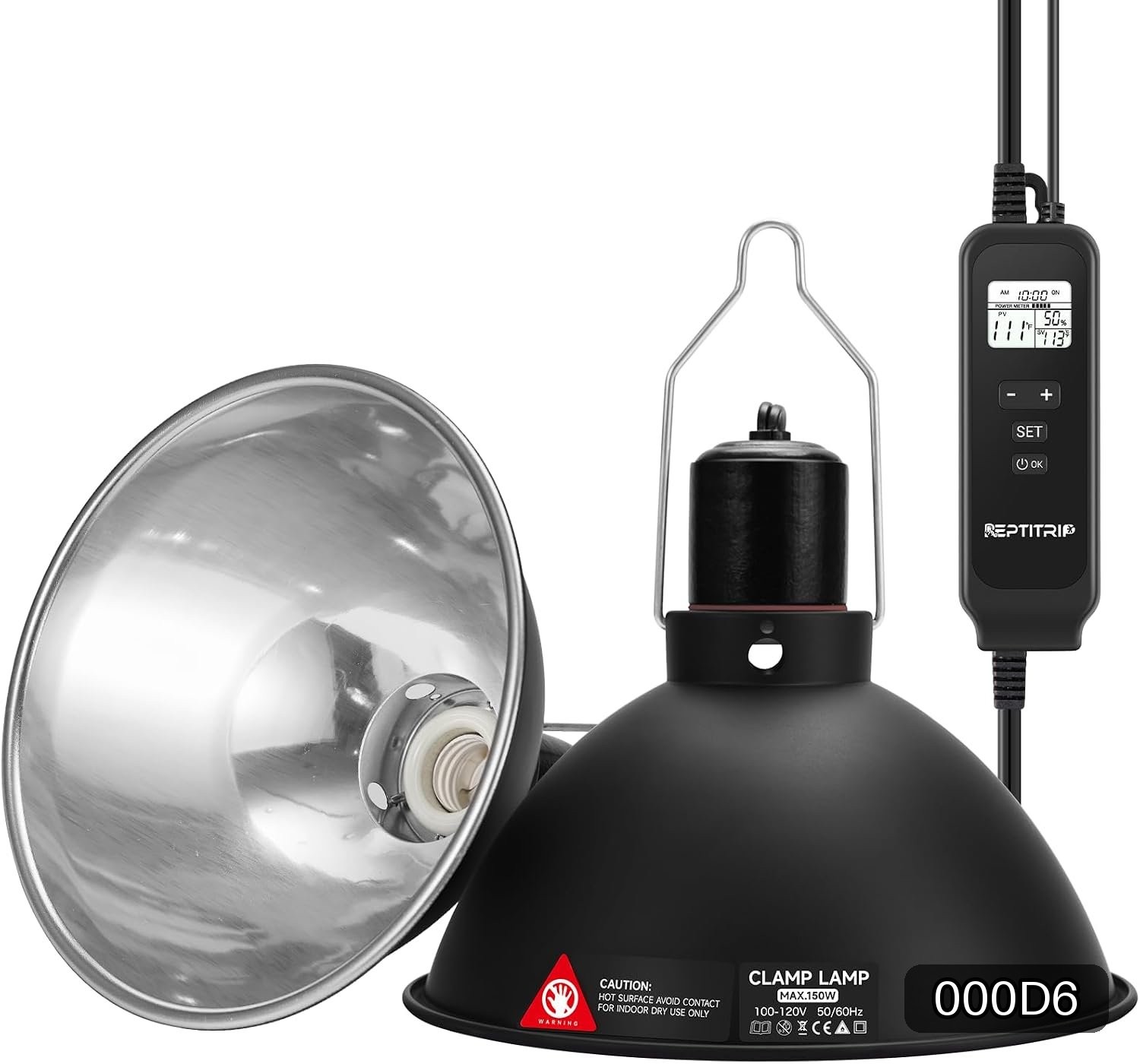

Photos from current listings. Actual item, color, and included accessories may vary.
Reptile Heat Lamp With Thermostat Buying Guide
A reptile heat lamp with thermostat bundles a radiant heat source (halogen, incandescent, or ceramic) with a PID or dimming controller to hold a precise basking temperature. The core trade-off is control architecture: cheap on/off bimetal thermostats swing several degrees and shorten bulb life, while PID dimming units regulate smoothly at the cost of higher upfront complexity. The decision rule is simple: buy a dimming PID thermostat rated above your bulb wattage if you need stable basking temps; skip any package that only lists a fixed-wattage fixture with no proportional control.
Key takeaways
- PID dimming thermostats modulate voltage continuously for ±1–2°F stability, while on/off bimetal units swing 5–10°F and cycle bulbs to early failure.
- Fixture dome size (5.5in vs 8.5in) controls beam spread and safe bulb wattage: 8.5in domes handle 150W–250W flood/spot lamps without heat trapping.
- Ceramic heat emitters (CHE) produce 24-hour IR heat with zero light, suitable for night use; halogen/incandescent provide visible basking light but must be off at night.
At a glance
- Category
- Reptile Heat & UVB Lighting
- Last updated
- Nov 27, 2026
Current offers
Highlights
- PID dimming thermostats modulate voltage continuously for ±1–2°F stability, while on/off bimetal units swing 5–10°F and cycle bulbs to early failure.
- Fixture dome size (5.5in vs 8.5in) controls beam spread and safe bulb wattage: 8.5in domes handle 150W–250W flood/spot lamps without heat trapping.
- Ceramic heat emitters (CHE) produce 24-hour IR heat with zero light, suitable for night use; halogen/incandescent provide visible basking light but must be off at night.
- Thermostat load rating must exceed bulb wattage by at least 20%—a 150W bulb needs a controller rated 180W+ continuous, not a marginal 150W limit.
Best use cases
- Best fit: keep a single basking zone at a precise temperature for bearded dragons, leopard geckos, or ball pythons—pick a dimming PID thermostat paired with an 8.5in dome and a 100–150W halogen or CHE.
- Best fit: night heat without light disruption for nocturnal species—use a ceramic heat emitter on a PID controller set to the species' night drop (e.g., 75–80°F for ball pythons).
- Wrong fit: skip on/off bimetal thermostat kits for any species requiring tight thermal gradients (chameleons, monitor lizards); the swing stresses animals and burns bulbs.
- Wrong fit: skip an 8.5in 150W+ dome on a small 10-gallon tank—the beam is too broad and overheats the whole enclosure; use a 5.5in dome with a lower-wattage bulb and dimmer.
Buying tips
- Match thermostat type to species: PID dimming for precise basking species (bearded dragons, uromastyx); pulse-proportional for CHE and deep-heat setups; avoid on/off for anything beyond basic backup.
- Size the dome to the bulb: 5.5in domes for 50–75W, 8.5in domes for 100–250W—undersized domes trap heat and crack bulbs or fixture housings.
- Check thermostat wattage headroom: choose a controller rated at least 20% above your highest-wattage bulb (e.g., 200W controller for a 150W bulb) to avoid relay or triac failure.
- Prefer fixtures with ceramic sockets and metal reflectors over plastic—high-wattage halogen and CHE bulbs run hot enough to deform cheap plastic fittings.
Specs
| Control Type | PID dimming vs on/off bimetal |
|---|---|
| Dome Size | 5.5in (50–75W) / 8.5in (100–250W) |
| Heat Source | Halogen / Incandescent / CHE |
| Load Headroom | 20% above bulb wattage minimum |
Related searches
What to check before buying
- Measure your enclosure's basking spot distance: a 150W bulb in an 8.5in dome at 12in typically delivers 100–110°F; adjust wattage or distance to hit species-specific basking temps.
- Confirm your wall outlet and controller plug standard match your region (US NEMA 1-15 vs EU Schuko) and that the thermostat's load rating covers your bulb wattage.
- Verify the fixture clamps or hangs securely on your tank rim or screen lid—8.5in domes with 150W bulbs are heavy and can tip lightweight mesh tops.
- Check whether your species needs UVB alongside heat: a heat-only thermostat setup does not provide UVB, so plan a separate linear UVB fixture for diurnal reptiles.
FAQ
Data sources: eBay / Amazon listings and product attribute feeds. Updated Nov 27, 2026.
Some links on this page are affiliate links. If you buy after clicking one, we may earn a commission at no extra cost to you. This does not change which products appear here or their order. Affiliate disclosure.