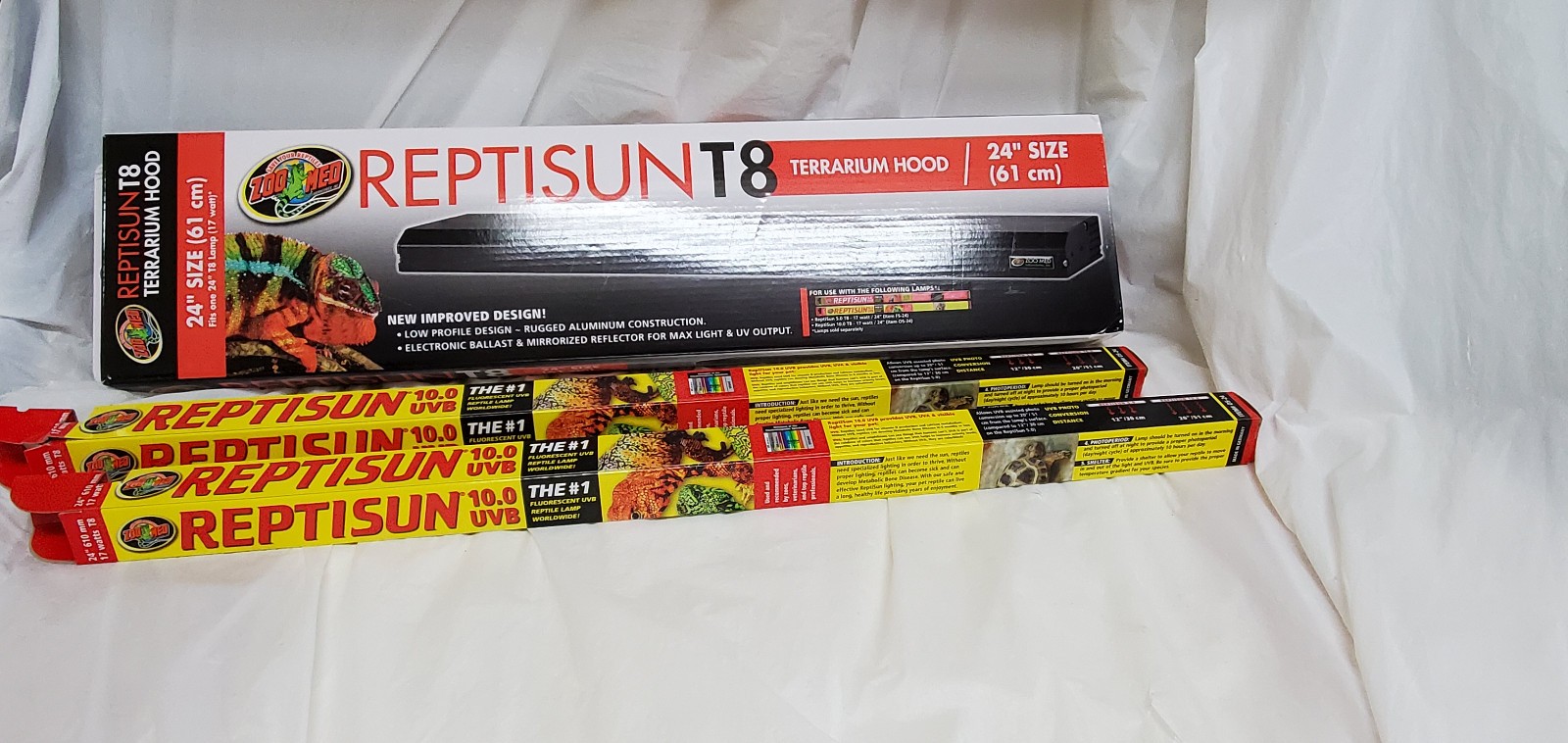

Photos from current listings. Actual item, color, and included accessories may vary.
Reptile Heat And Uvb Lighting Buying Guide
Reptile heat and UVB lighting is a life-support system, not decor: it sets your animal's metabolism, digestion, and calcium processing. The core trade-off is between cheap analog bulbs and digitally controlled, species-correct output—wrong spectrum or uncontrolled heat causes metabolic bone disease or thermal burns. The decision rule: match a specific basking temperature and UV Index (UVI) to your species, then buy dimmable/thermostat-ready fixtures with a known UVB gradient, not bundled kits with unrated bulbs.
Key takeaways
- UVB output follows an inverse-square gradient: UVI drops roughly 75% from 12 in to 24 in, so fixture height and mesh screening decide usable UVB more than bulb wattage.
- Linear T5 HO fluorescent tubes with individual reflectors deliver uniform UVB across a 24–36 in basking zone; compact coils concentrate UVB in a narrow cone and are best for small enclosures only.
- Halogen and deep heat projector bulbs produce infrared-A and infrared-B for deep tissue warming and better night-cycle simulation than ceramic heat emitters, which emit only long-wave IR-C.
At a glance
- Category
- Reptile Heat & UVB Lighting
- Last updated
- Nov 27, 2026
Current offers
Highlights
- UVB output follows an inverse-square gradient: UVI drops roughly 75% from 12 in to 24 in, so fixture height and mesh screening decide usable UVB more than bulb wattage.
- Linear T5 HO fluorescent tubes with individual reflectors deliver uniform UVB across a 24–36 in basking zone; compact coils concentrate UVB in a narrow cone and are best for small enclosures only.
- Halogen and deep heat projector bulbs produce infrared-A and infrared-B for deep tissue warming and better night-cycle simulation than ceramic heat emitters, which emit only long-wave IR-C.
- Dimmable thermostats and pulse-proportional controllers prevent overshoot; on/off thermostats swing 5–10°F and are unsuitable for precise basking species like beardies and chameleons.
Best use cases
- Desert basking species (bearded dragon, uromastyx, leopard gecko): pick a T5 HO 10–12% UVB tube plus a halogen basking bulb on a dimming thermostat—skip compact coils and red night bulbs.
- Tropical/forest species (crested gecko, day gecko, chameleon): use a T5 HO 5–6% UVB tube and low-wattage halogen or LED heat, with dense foliage for a UVB retreat zone—skip 12% desert tubes.
- Nocturnal/crepuscular species (leopard gecko, ball python): a low-level 2–5% UVB tube plus a deep heat projector or ceramic emitter on a thermostat supports natural calcium metabolism—skip high-output desert lamps.
- Large enclosures over 4 ft: use two overlapping T5 HO tubes or a metal-halide UVB flood for even coverage and a separate heat gradient—skip single coils that leave half the tank dark.
Buying tips
- Measure basking distance first: a T5 HO 10% tube at 12–14 in yields UVI ~3–5 for desert species; at 24 in the same bulb may fall below UVI 1, so plan fixture height before wattage.
- Match UVB percentage to species: 5–6% for tropical/forest, 10–12% for desert, 2–5% for crepuscular—higher percentages need greater mounting distance to avoid overexposure.
- Choose dimming-capable halogen or deep heat projectors with a pulse-proportional thermostat; a 50–100W halogen dimmed to 60% lasts longer and holds stable basking temps than an on/off 100W bulb.
- Replace T5 HO UVB tubes every 9–12 months and metal-halide bulbs per manufacturer interval; UVB decays before visible failure, so a calendar log beats eyeballing brightness.
Specs
| UVB Source | T5 HO tube / compact coil / metal halide |
|---|---|
| UVB Percentage | 2–5% crepuscular / 5–6% tropical / 10–12% desert |
| Heat Emitter Type | Halogen / deep heat projector / ceramic IR-C |
| Control | Dimming or pulse-proportional thermostat |
Related searches
What to check before buying
- Measure enclosure height and mesh-top distance from basking spot to fixture; verify the bulb's rated UVI at that exact distance (most brands publish a distance/UVI chart).
- Confirm fixture voltage and plug standard match your region (120V NEMA 1-15 for North America; 230V Type G/F for UK/EU) and that the fixture is rated for the bulb wattage.
- Check thermostat compatibility: dimming fixtures require a pulse-proportional or dimming thermostat, not a simple on/off unit, to hold stable basking temperatures.
- Verify enclosure screen mesh blocks UVB—fine aluminum or fiberglass mesh can cut UVB 30–50%, so either use wide-gauge mesh or raise bulb output/distance accordingly.
FAQ
Data sources: eBay / Amazon listings and product attribute feeds. Updated Nov 27, 2026.
Some links on this page are affiliate links. If you buy after clicking one, we may earn a commission at no extra cost to you. This does not change which products appear here or their order. Affiliate disclosure.