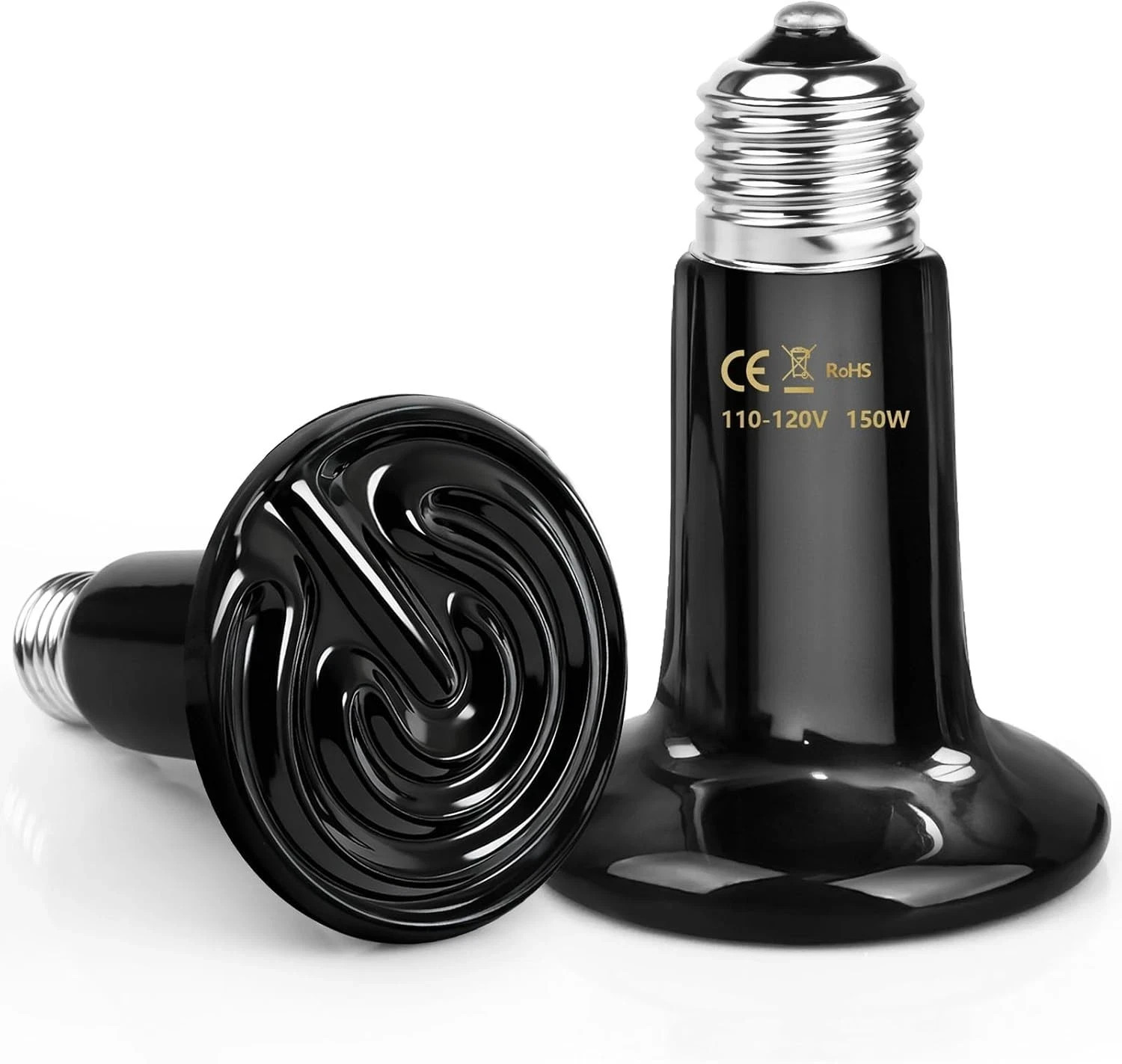

Photos from current listings. Actual item, color, and included accessories may vary.
Heat Light Bulb Buying Guide
A reptile heat light bulb is a basking lamp engineered to deliver radiant heat and, in some models, UVB for ectotherm thermoregulation and calcium metabolism. The core trade-off is between cheap incandescent-style basking bulbs that burn out unpredictably and higher-grade halogen, deep-heat, or mercury-vapor designs with stable output, correct beam spread, and UVB compliance. Buy halogen or dedicated basking bulbs with a known wattage/beam profile for heat-only setups, and only choose UVB-emitting or mercury-vapor bulbs when the fixture and distance math support the species' UV index.
Key takeaways
- Halogen basking bulbs produce more heat per watt than standard incandescent and hold output steadier over life; use them for daytime basking in heat-only setups.
- Mercury vapor UVB bulbs combine heat and UVB in one lamp but require a ceramic or high-temp fixture rated for the wattage and a minimum mounting distance per the lamp's UV chart.
- Deep heat projectors emit infrared-B and infrared-A with little visible light, making them suitable for nighttime or 24-hour ambient heat where light disruption is unwanted.
At a glance
- Category
- Reptile Heat & UVB Lighting
- Last updated
- Nov 27, 2026
Current offers
Highlights
- Halogen basking bulbs produce more heat per watt than standard incandescent and hold output steadier over life; use them for daytime basking in heat-only setups.
- Mercury vapor UVB bulbs combine heat and UVB in one lamp but require a ceramic or high-temp fixture rated for the wattage and a minimum mounting distance per the lamp's UV chart.
- Deep heat projectors emit infrared-B and infrared-A with little visible light, making them suitable for nighttime or 24-hour ambient heat where light disruption is unwanted.
- Ceramic heat emitters produce no light and are the standard for nighttime heat; they must sit in a ceramic socket rated for the emitter's wattage, not a plastic dome.
Best use cases
- Best fit: desert and basking species (bearded dragon, uromastyx) — use a halogen basking bulb plus a linear T5 UVB tube; skip coil UVB compact bulbs for these setups.
- Best fit: nocturnal or light-sensitive species — use a ceramic heat emitter or deep heat projector on a thermostat; skip colored night bulbs, which still emit visible light.
- Best fit: large enclosures needing one heat-and-UVB source — use a mercury vapor bulb in a wide ceramic fixture at the manufacturer's minimum distance; skip it in small tanks where distance cannot be met.
- Wrong fit: using a heat bulb alone as the sole UVB source for diurnal reptiles — pair heat with a separate UVB tube unless the bulb is explicitly a mercury vapor UVB lamp.
Buying tips
- Match wattage to enclosure volume and ambient room temperature: a 40W–60W bulb suits a small screen-top dome over a 20–40 gallon tank; 75W–150W is typical for 4x2x2 ft enclosures with a basking spot.
- Use a dimming thermostat or pulse-proportional thermostat with all heat bulbs and emitters; on/off thermostats shorten halogen and incandescent bulb life through frequent cycling.
- Keep the basking bulb in a ceramic-socket dome rated above the bulb wattage; plastic sockets and undersized domes are the leading cause of fixture failure and fire risk.
- For UVB, follow the lamp's distance-to-UV-index chart: T5 HO tubes at roughly 12–18 in and mercury vapor bulbs at the specified minimum distance; measured UV index, not wattage alone, determines safety.
Specs
| Bulb Type | Halogen / Incandescent / MVB / DHP / CHE |
|---|---|
| Wattage Range | 40W–150W (basking); 60W–150W (CHE) |
| UVB Output | None / 5.0–10.0 / 12%+ T5 HO |
| Socket Type | E26/E27 ceramic, rated ≥ bulb wattage |
Related searches
What to check before buying
- Measure enclosure height and basking-spot distance: the bulb must sit at the lamp's rated distance from the animal, especially for mercury vapor and UVB bulbs.
- Confirm fixture socket type and wattage rating (ceramic E26/E27 socket rated for the bulb's wattage) and that the dome can handle the heat output.
- Check your thermostat and timer setup: dimming or pulse-proportional thermostat for heat bulbs, and a separate timer for the day/night photoperiod.
- Verify the bulb's beam angle and spread covers the basking platform without overheating the cool zone; use a wider flood for large enclosures and a narrow spot for concentrated basking.
FAQ
Data sources: eBay / Amazon listings and product attribute feeds. Updated Nov 27, 2026.
Some links on this page are affiliate links. If you buy after clicking one, we may earn a commission at no extra cost to you. This does not change which products appear here or their order. Affiliate disclosure.