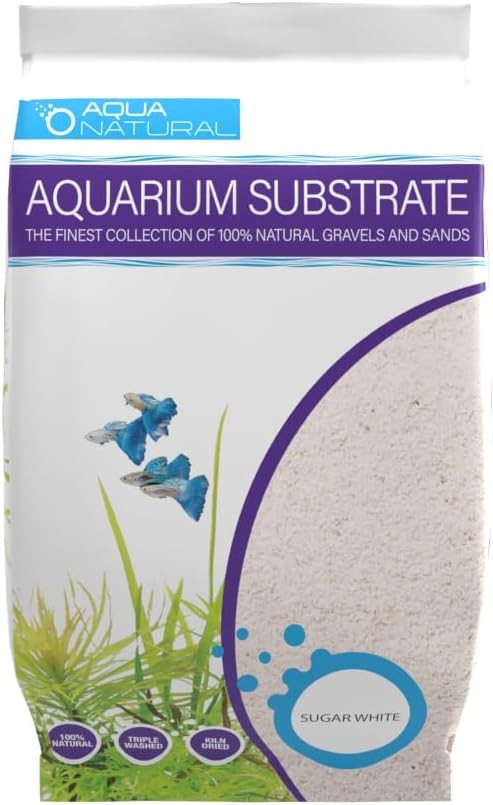

Photos from current listings. Actual item, color, and included accessories may vary.
Aqua Natural Aquarium Substrate Buying Guide
Aqua Natural aquarium substrate is a brand family of natural sands and gravels sold by grain size and color, with 'Sugar White Sand' being a fine 0.5–1 mm aragonite-based option. The core trade-off is grain size versus chemistry: fine sand looks clean and suits bottom-dwellers, but it compacts, clouds if unrinsed, and aragonite raises pH and hardness. Buy it only if you want a bright, natural, buffering substrate for hard-water or brackish setups; skip it for soft-water, acidic, or high-flow planted tanks that need coarse, inert, or nutrient-rich media.
Key takeaways
- Sugar White Sand is aragonite (calcium carbonate), not silica: it buffers KH and lifts pH toward 8.0–8.4, ideal for African cichlids, livebearers, and brackish tanks.
- Fine 0.5–1 mm grains pack tight, so use a 1–2 inch bed max; deeper beds go anaerobic and risk hydrogen-sulfide pockets.
- Aragonite dissolves slowly and steadily, so it keeps buffering for years rather than one water change — no re-dosing needed in hard-water tanks.
At a glance
- Category
- Aquarium Substrate, Plants & Decor
- Last updated
- Nov 27, 2026
Current offers
Highlights
- Sugar White Sand is aragonite (calcium carbonate), not silica: it buffers KH and lifts pH toward 8.0–8.4, ideal for African cichlids, livebearers, and brackish tanks.
- Fine 0.5–1 mm grains pack tight, so use a 1–2 inch bed max; deeper beds go anaerobic and risk hydrogen-sulfide pockets.
- Aragonite dissolves slowly and steadily, so it keeps buffering for years rather than one water change — no re-dosing needed in hard-water tanks.
- White aragonite reflects light and shows detritus fast; dark or mixed gravel hides waste better but offers no buffering.
Best use cases
- Best fit: African cichlid, livebearer, goldfish, or brackish tanks needing stable high pH — use 1–2 inches of Sugar White Sand with a light rinse.
- Best fit: show tanks or breeding tanks where a bright, uniform bed suits bottom sifters — pair with a pre-filter sponge to keep fines out of the filter.
- Wrong fit: discus, cardinal tetra, crystal shrimp, or acidic blackwater tanks — aragonite pushes pH the wrong way; choose inert silica sand or aquasoil.
- Wrong fit: high-flow or heavily planted high-tech tanks — fine sand compacts and uproots; use 2–3 mm gravel or a capped soil layer instead.
Buying tips
- Match grain to stock: 0.5–1 mm sand for cories and loaches, 2–3 mm gravel for plants and high flow, 3–5 mm for large cichlids that rearrange scapes.
- Size the bag by volume, not weight: a 10 lb bag fills roughly a 10-gallon tank to 1 inch; scale to 1–2 lb per gallon for a 1–2 inch bed.
- Buy aragonite only for hard-water species; for neutral or soft-water fish choose inert silica or quartz sand and buffer separately if needed.
- Rinse in small batches until runoff clears — fine aragonite clouds tanks for days if dumped straight from the bag.
Specs
| Grain Size | Fine 0.5–1 mm sand / 2–3 mm gravel |
|---|---|
| Chemistry | Aragonite (buffering) vs silica (inert) |
| pH Effect | Raises to 8.0–8.4 / neutral inert |
| Bed Depth | 1–2 in max for fine sand |
Related searches
What to check before buying
- Measure tank footprint and target bed depth: length × width × depth in inches ÷ 20 gives pounds of sand needed for a 1-inch layer.
- Confirm your species' pH and KH range before buying buffering aragonite — it raises both and is hard to reverse once in the tank.
- Check filter intake height and add a pre-filter sponge so fine sand does not score the impeller.
- Verify the bag is labeled aragonite or calcium carbonate if you want buffering; white silica sand looks similar but is inert.
FAQ
Data sources: eBay / Amazon listings and product attribute feeds. Updated Nov 27, 2026.
Some links on this page are affiliate links. If you buy after clicking one, we may earn a commission at no extra cost to you. This does not change which products appear here or their order. Affiliate disclosure.