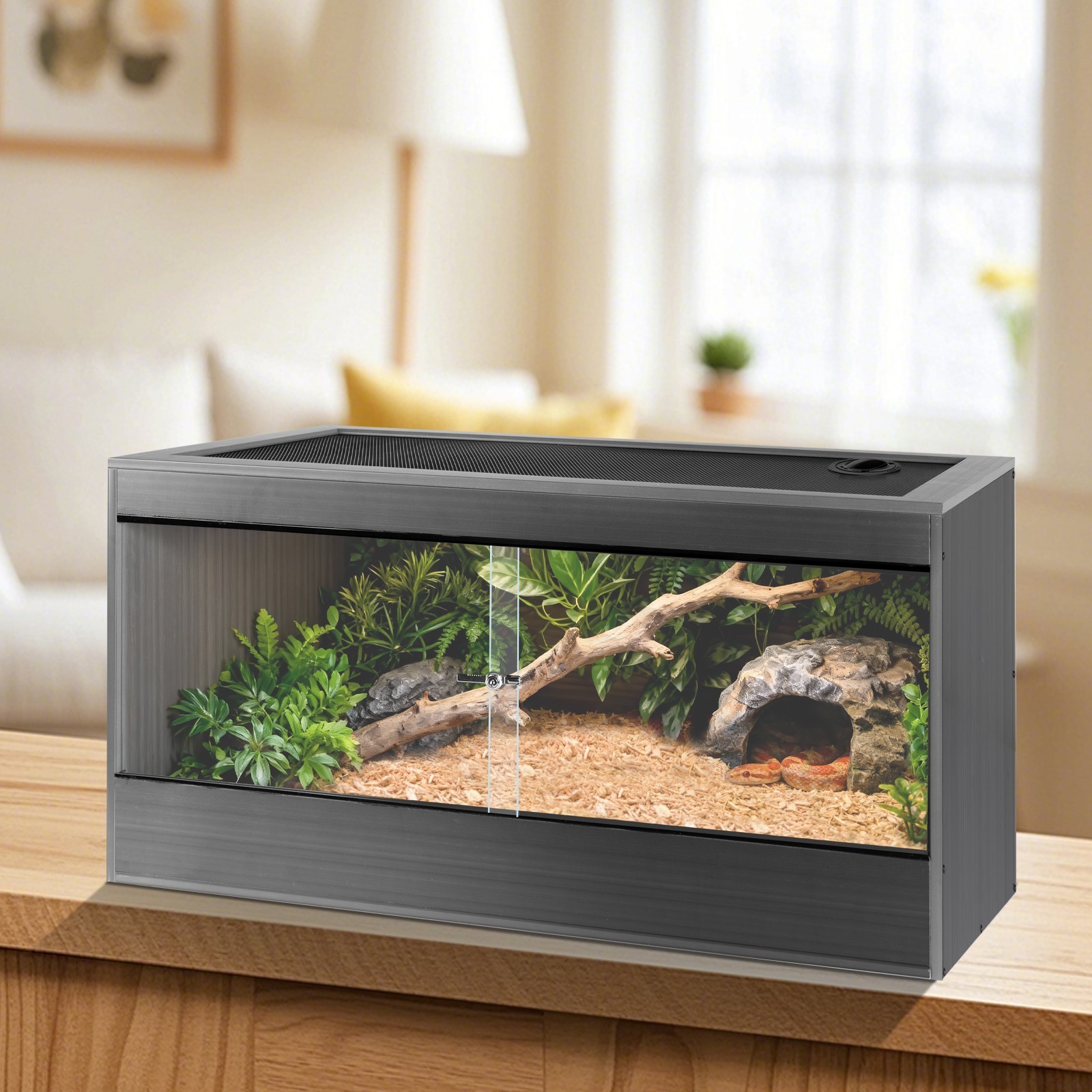

Photos from current listings. Actual item, color, and included accessories may vary.
Reptile Enclosure Wood Buying Guide
Wood reptile enclosures are built from composite panels (melamine-faced MDF, plywood, or sealed pine) that trade low cost and easy custom sizing for moisture vulnerability—the single factor separating a decade-long terrarium from a swelling, mold-prone one. The decisive rule: buy only panels sealed on all faces and edges (or specify marine-grade plywood/expanded PVC), and match panel thickness (minimum 1/2 in, ideally 3/4 in) to enclosure span and species humidity.
Key takeaways
- Panel cores differ: melamine-faced MDF is cheapest but swells permanently at cut edges; plywood (especially marine grade) and expanded PVC resist moisture far better.
- 18 in height suits terrestrial and semi-arboreal species; arboreal snakes and chameleons need 24-36 in vertical space with screen or hybrid tops.
- Sliding glass doors on 36x18x18 in footprints require a routed track and 3/16-1/4 in glass or acrylic; acrylic scratches but is lighter and cheaper to ship.
At a glance
- Category
- Reptile Enclosures & Terrariums
- Last updated
- Nov 27, 2026
Current offers
Highlights
- Panel cores differ: melamine-faced MDF is cheapest but swells permanently at cut edges; plywood (especially marine grade) and expanded PVC resist moisture far better.
- 18 in height suits terrestrial and semi-arboreal species; arboreal snakes and chameleons need 24-36 in vertical space with screen or hybrid tops.
- Sliding glass doors on 36x18x18 in footprints require a routed track and 3/16-1/4 in glass or acrylic; acrylic scratches but is lighter and cheaper to ship.
- Seal every cut edge and screw hole with waterproof silicone or polyurethane; unsealed MDF wicks water and supports mold within weeks at 70-80% humidity.
Best use cases
- Best fit: 36x18x18 in (50 gal equivalent) composite-wood enclosure with sliding doors for leopard geckos, corn snakes, and juvenile ball pythons—choose it for dry-to-moderate humidity species.
- Wrong fit: high-humidity species (crested geckos, dart frogs, emerald tree skinks) in unsealed MDF—specify marine-grade plywood or expanded PVC instead, or the panel will swell and delaminate.
- Best fit: DIY buyers who can cut and seal panels themselves—wood kits offer the most enclosure per dollar and exact custom dimensions; skip if you cannot seal edges properly.
- Wrong fit: stacking multiple units for a rack—solid wood panels are heavy; factor 40-60 lb for a 36 in enclosure and reinforce shelves accordingly.
Buying tips
- Match panel thickness to span: 1/2 in MDF flexes on spans over 36 in; choose 3/4 in (18 mm) for any enclosure 48 in or longer, or add a center brace.
- Seal all six faces and every cut edge with two coats of waterproof polyurethane or silicone—factory melamine coating alone does not protect routed door tracks and vent cutouts.
- For humidity above 60%, specify marine-grade plywood (BS 1088 or equivalent) or expanded PVC; standard MDF is not suitable for misted setups.
- Confirm glass/acrylic thickness: 3/16 in (4-5 mm) suits doors up to 24 in tall; 1/4 in is safer for larger panels and prevents bowing under heat-lamp warmth.
Specs
| Panel Core | Melamine MDF / Plywood / PVC |
|---|---|
| Panel Thickness | 1/2 in (12 mm) to 3/4 in (18 mm) |
| Door Type | Sliding glass / acrylic / hinged |
| Humidity Suitability | Dry <60% MDF; Humid >60% PVC/ply |
Related searches
What to check before buying
- Measure your stand or shelf footprint: a 36x18 in enclosure needs at least 37x19 in of flat support and 24 in clearance above for heat/UV fixtures.
- Verify room humidity and species requirement: if target humidity exceeds 60%, upgrade from MDF to marine plywood or PVC before buying.
- Check vent placement: cross-ventilation at both ends is mandatory for wood enclosures to prevent stagnant humid air and mold.
- Plan heat sources: ceramic heat emitters and radiant panels must sit on a thermostat and never contact wood directly—allow 4-6 in clearance and use a cage guard.
FAQ
Data sources: eBay / Amazon listings and product attribute feeds. Updated Nov 27, 2026.
Some links on this page are affiliate links. If you buy after clicking one, we may earn a commission at no extra cost to you. This does not change which products appear here or their order. Affiliate disclosure.