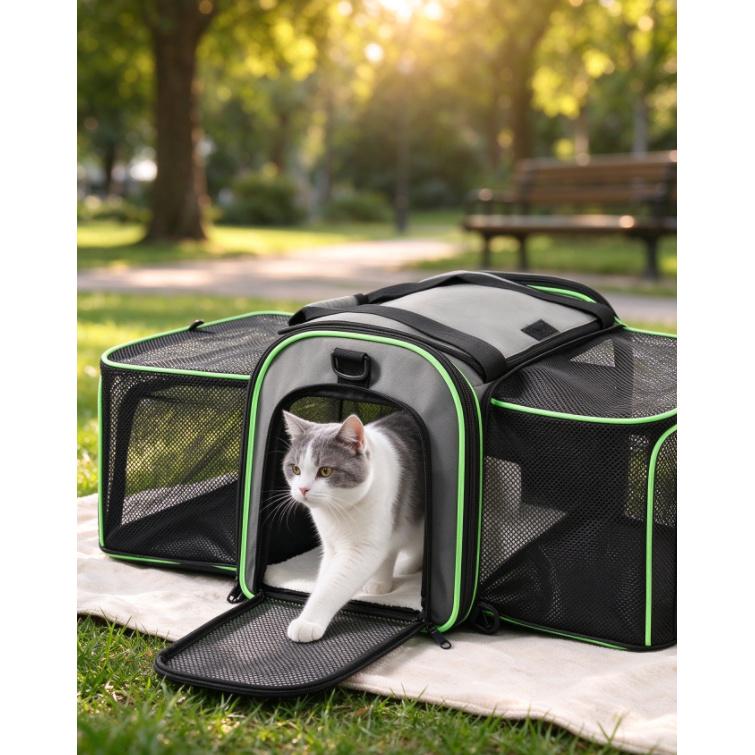

Photos from current listings. Actual item, color, and included accessories may vary.
Extra Large Cat Carrier Buying Guide
An extra-large cat carrier is a soft-sided or expandable transport bag sized for multi-cat households or large breeds (Maine Coon, Ragdoll) exceeding 15 lb. The core trade-off is structured frame and ventilation versus collapsible portability—cheap carriers skimp on internal wire framing and mesh GSM, causing sag and claw tears. The decision rule: buy only carriers rated by internal dimensions and load-bearing frame, not by 'large' marketing labels.
Key takeaways
- Soft-sided carriers rely on internal wire or plastic rib framing; without a rigid base insert, the floor sags under cats over 15 lb.
- Airline cabin compliance caps most soft carriers at 18×11×11 in; extra-large models typically exceed this and must be checked as cargo.
- Mesh ventilation panels should be 600D+ Oxford fabric with reinforced stitching at zipper seams to resist claw punctures.
At a glance
- Category
- Pet Travel & Safety
- Last updated
- Nov 28, 2026
Current offers
Highlights
- Soft-sided carriers rely on internal wire or plastic rib framing; without a rigid base insert, the floor sags under cats over 15 lb.
- Airline cabin compliance caps most soft carriers at 18×11×11 in; extra-large models typically exceed this and must be checked as cargo.
- Mesh ventilation panels should be 600D+ Oxford fabric with reinforced stitching at zipper seams to resist claw punctures.
- Expandable backpack styles add 4–6 in of depth via zip-out mesh pockets, boosting volume without changing the base footprint.
Best use cases
- Best fit: multi-cat households or one cat over 15 lb—choose a soft-sided carrier with rigid base board and internal dimensions of at least 19×12×12 in.
- Best fit: car and vet trips with a large breed—pick a carrier with seatbelt loops and a machine-washable fleece pad.
- Wrong fit: airline cabin travel with an extra-large carrier—most exceed 18×11×11 in limits; use a compliant medium carrier or cargo crate.
- Wrong fit: cats that claw or chew—skip thin nylon mesh; choose 600D Oxford with metal zipper pulls and reinforced seams.
Buying tips
- Measure your cat nose-to-tail-base and add 4 in length and 3 in height; pick a carrier whose internal dimensions exceed that figure.
- Weight rating is unreliable—check the base board thickness (5mm+ ABS or plywood) and internal frame rods, which carry the load.
- For two cats, choose a double-compartment or 24-in-wide carrier; single-door extra-large bags cause crowding and stress.
- Prefer carriers with top-loading and front-loading doors; top access is essential for lifting heavy cats without tipping the bag.
Specs
| Carrier Type | Soft-sided / Hard-sided / Backpack |
|---|---|
| Internal Dimensions | 19×12×12 in and up |
| Weight Capacity | Up to 20–25 lb |
| Frame & Base | Internal wire frame + rigid base |
Related searches
What to check before buying
- Measure your cat's length (nose to tail base) and standing height; internal carrier dimensions must exceed both by 3–4 in.
- Confirm your vehicle seat width and seatbelt loop placement if using the carrier for car travel.
- Check airline cabin size limits (commonly 18×11×11 in) before buying an extra-large carrier for flights.
- Verify the carrier includes a rigid base insert and washable pad; these are often sold separately on budget models.
FAQ
Data sources: eBay / Amazon listings and product attribute feeds. Updated Nov 28, 2026.
Some links on this page are affiliate links. If you buy after clicking one, we may earn a commission at no extra cost to you. This does not change which products appear here or their order. Affiliate disclosure.