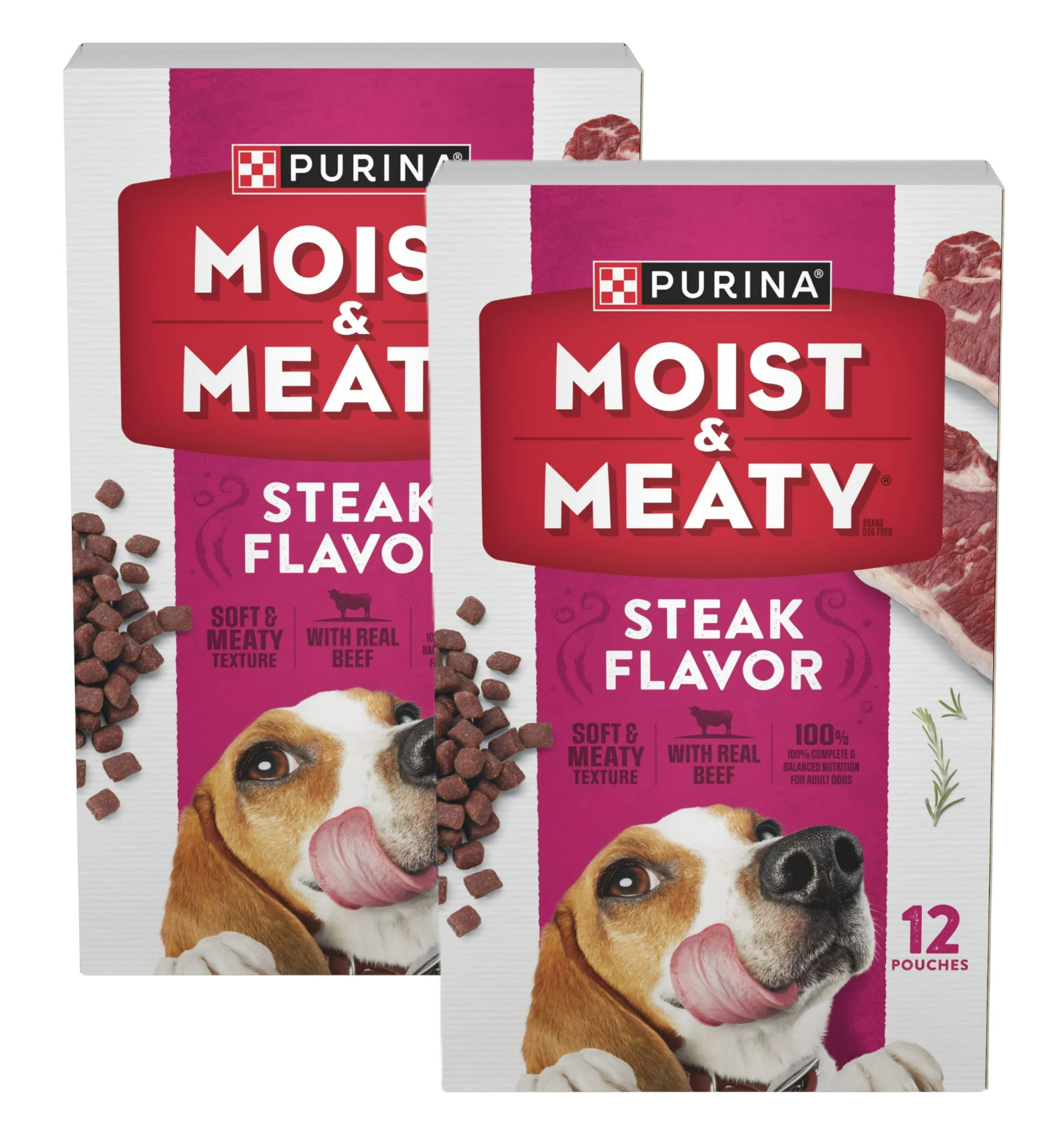

Photos from current listings. Actual item, color, and included accessories may vary.
Moist And Meaty Dog Food Buying Guide
Moist and meaty dog food sits between dry kibble and canned wet food—soft, high-moisture pieces that appeal to picky eaters and senior dogs, but the segment hides a wide quality gap. The primary trade-off is palatability and convenience versus actual animal-protein content and preservative load; many budget pouches are grain-heavy and artificially colored, while premium soft kibbles use real meat first and natural preservation. The decision rule: buy only formulas that list a named meat as the first ingredient and guarantee crude protein at 25% or higher on a dry-matter basis, and skip any pouch relying on meat by-products, added sugars, or propylene glycol as a softener.
Key takeaways
- Moisture content dictates shelf life and texture: soft kibbles run 18-25% moisture (shelf-stable pouch), while 'meaty' chunks in gravy run 75-82% moisture and require refrigeration after opening.
- Protein quality is a dry-matter calculation, not a label number: a 10% crude protein at 20% moisture equals only 12.5% dry-matter protein, versus 25% protein at 18% moisture equaling 30.5% dry-matter.
- Soft textures are achieved either mechanically (high-moisture extrusion) or chemically (propylene glycol, glycerin, added sugars)—the latter is common in budget 'meaty' treats and should be avoided for daily feeding.
At a glance
- Category
- Pet Food, Treats & Litter
- Last updated
- Nov 28, 2026
Current offers
Highlights
- Moisture content dictates shelf life and texture: soft kibbles run 18-25% moisture (shelf-stable pouch), while 'meaty' chunks in gravy run 75-82% moisture and require refrigeration after opening.
- Protein quality is a dry-matter calculation, not a label number: a 10% crude protein at 20% moisture equals only 12.5% dry-matter protein, versus 25% protein at 18% moisture equaling 30.5% dry-matter.
- Soft textures are achieved either mechanically (high-moisture extrusion) or chemically (propylene glycol, glycerin, added sugars)—the latter is common in budget 'meaty' treats and should be avoided for daily feeding.
- Real-meat-first formulas name the animal (beef, chicken, lamb) in the first slot; by-product meals and 'meat and bone meal' are rendered scraps with variable nutrient density and lower digestibility.
Best use cases
- Best fit: senior dogs or dogs with dental sensitivity—choose a soft-kibble formula with 20-25% moisture and 25%+ dry-matter protein as a complete meal, not a topper.
- Best fit: picky eaters who refuse dry kibble—use a moist-and-meaty kibble as the base diet only if it meets AAFCO complete-and-balanced statements for the dog's life stage.
- Wrong fit: dogs needing strict portion control or weight loss—soft foods are calorie-dense per volume; skip and use a measured dry kibble with a guaranteed calorie count instead.
- Wrong fit: owners expecting raw-level nutrition—moist pouches are cooked and preserved; choose a frozen raw or freeze-dried complete diet if that is the goal.
Buying tips
- Look for the AAFCO nutritional adequacy statement on the package: 'complete and balanced' for the specific life stage (growth, adult maintenance, all life stages) is non-negotiable for a primary diet.
- Calculate dry-matter protein: divide crude protein by (100 minus moisture percentage), then multiply by 100—target 25% or higher for adult dogs and 28%+ for puppies.
- Check the first three ingredients: a named meat (beef, chicken, lamb) should lead, and avoid formulas where corn, wheat, or soy outrank all animal sources.
- Match the format to feeding routine: shelf-stable soft kibble for free-feeding or travel; pouch-and-gravy only if you can refrigerate leftovers and feed within 3 days.
Specs
| Moisture Content | 18-25% soft kibble / 75-82% pouch |
|---|---|
| Protein (dry matter) | 25-32% adult / 28%+ puppy |
| First Ingredient | Named meat (beef, chicken, lamb) |
| AAFCO Statement | Complete & balanced by life stage |
Related searches
What to check before buying
- Measure your dog's current kibble portion in grams and compare calorie density—soft foods often run 350-400 kcal per cup versus 300-350 for dry, so adjust portions to avoid weight gain.
- Confirm package size fits your feeding window: an opened 24-count soft-kibble box stays fresh 4-6 weeks; pouches last 3 days refrigerated.
- Verify the protein source against any known allergies—beef, chicken, and lamb are the common bases; limited-ingredient formulas use single novel proteins like salmon or venison.
- Check life-stage labeling against your dog's age: puppy formulas need higher calcium-phosphorus ratios and DHA, which adult moist foods typically lack.
FAQ
Data sources: eBay / Amazon listings and product attribute feeds. Updated Nov 28, 2026.
Some links on this page are affiliate links. If you buy after clicking one, we may earn a commission at no extra cost to you. This does not change which products appear here or their order. Affiliate disclosure.