
Photos from current listings. Actual item, color, and included accessories may vary.
Tactical Dog Harness With Handle Buying Guide
A tactical dog harness with handle is a load-bearing vest built from high-denier nylon webbing and reinforced stitching, using a top-mounted control handle plus front and back leash points to manage pulling and lifting. The core trade-off is between mil-spec materials and hardware (1000D Cordura, aluminum D-rings, bar-tacked seams) versus thin polyester shells with plastic buckles that fail under load. Buy the heavy-webbing, metal-hardware tier for working or strong-pulling dogs; skip featherweight fashion vests for any dog over roughly 25 lb.
Key takeaways
- Shell fabric grade decides abrasion life: 1000D Cordura or 1050D ballistic nylon outlasts 600D polyester by a wide margin under brush, concrete, and repeated washing.
- Metal load hardware beats plastic: welded aluminum or steel D-rings and cobra-style side-release buckles hold rated loads; molded plastic D-rings are a known break point.
- Control handle must be bar-tack stitched through a reinforced spine panel, not sewn to a single layer of shell fabric, or it tears out during lift-assist.
At a glance
- Category
- Pet Collars, Harnesses & Leashes
- Last updated
- Nov 28, 2026
Current offers
Highlights
- Shell fabric grade decides abrasion life: 1000D Cordura or 1050D ballistic nylon outlasts 600D polyester by a wide margin under brush, concrete, and repeated washing.
- Metal load hardware beats plastic: welded aluminum or steel D-rings and cobra-style side-release buckles hold rated loads; molded plastic D-rings are a known break point.
- Control handle must be bar-tack stitched through a reinforced spine panel, not sewn to a single layer of shell fabric, or it tears out during lift-assist.
- Front no-pull leash point changes gait mechanics by steering the chest; back point suits tracking and long-line work, so dual-point designs cover both training modes.
Best use cases
- Best fit: strong pullers and working-breed dogs over 25 lb — pick a 1000D shell with metal D-rings and a padded handle for daily control and lift-assist.
- Best fit: hiking, SAR, and service-dog tasks — choose a dual-attachment vest with MOLLE webbing and reflective trim for gear mounting and low-light visibility.
- Wrong fit: toy and small-breed dogs under about 15 lb — skip tactical vests; their hardware and shell weight overload small frames, so use a lightweight step-in harness.
- Wrong fit: flat-faced (brachycephalic) breeds — avoid chest-heavy tactical cuts that ride the throat; select a Y-front or strap harness that clears the trachea.
Buying tips
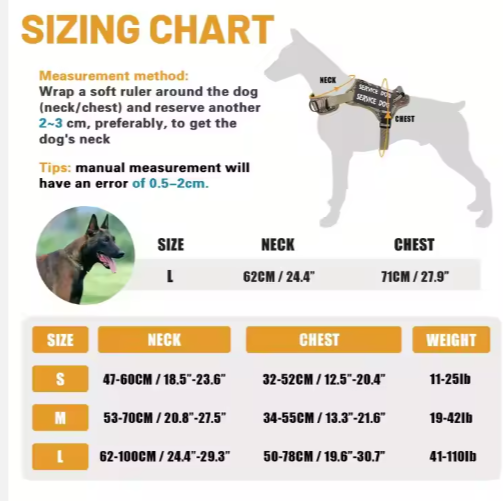
- Measure girth at the widest rib point and add 2 in (5 cm) for adjustment range; a harness with under 3 in of total adjustment will not fit a growing or thick-coated dog.
- Match webbing width to weight: 1 in (25 mm) webbing for dogs up to about 60 lb, 1.5 in (38 mm) for 60-100 lb, and 2 in (50 mm) for dogs over 100 lb.
- Demand bar-tack or box-X stitching at every strap junction; single straight stitching at the handle and D-ring anchors is the first failure point.
- Choose metal side-release buckles or aluminum D-rings over molded plastic for any dog that lunges; plastic hardware is the most common field-failure component.
Specs
| Shell Fabric | 1000D Cordura vs 600D polyester |
|---|---|
| Hardware | Metal D-rings vs plastic |
| Leash Points | Front + back dual vs single |
| Handle Rating | Lift-assist bar-tacked vs steadying only |
Related searches
What to check before buying
- Girth measurement: chest circumference at the widest rib point plus 2 in of slack — verify the harness adjustment range covers it.
- Neck opening: confirm the collar/neck loop clears the head without choking and sits above the shoulders, not on the throat.
- Handle clearance: check the control handle sits above the shoulder blades, not on the neck, so lifting does not torque the spine.
- Climate and coat: thick double coats need wider strap spacing and smooth lining; hot climates favor ventilated mesh panels over full Cordura coverage.
FAQ
Data sources: eBay / Amazon listings and product attribute feeds. Updated Nov 28, 2026.
Some links on this page are affiliate links. If you buy after clicking one, we may earn a commission at no extra cost to you. This does not change which products appear here or their order. Affiliate disclosure.