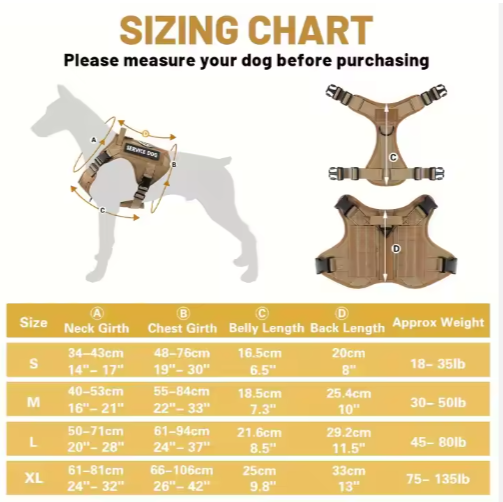

Photos from current listings. Actual item, color, and included accessories may vary.
Service Dog Vest With Handle Buying Guide
A service dog vest with handle is a mobility-support harness that combines a close-fitting vest body with a rigid grab handle so a handler can steady, guide, or physically assist the dog in public access work. The core trade-off is between light comfort padding and structural load-bearing: thin fabric vests with stitched web handles flex and tear under a handler's pull, while true service-grade rigs use bar-tacked webbing, reinforced handle anchors, and metal hardware rated for sustained tension. If the dog will ever be lifted, braced against, or restrained by the handle, buy a load-rated harness with metal buckles and a padded chest plate; if the vest is purely for identification and light steering, a reflective fabric vest with a stitched handle is sufficient.
Key takeaways
- Handle construction is the durability bottleneck: bar-tacked or box-X stitched webbing anchored through multiple layers of vest fabric and webbing distributes load, while single-row stitching on thin fabric is the first failure point.
- Metal buckles and D-rings (aluminum or steel) handle load and abrasion far better than plastic side-release buckles, which can crack under brace tension or cold-weather flex.
- Tactical-style vests use dense woven nylon or polyester with MOLLE webbing for modular pouches, while basic service vests use lighter padded mesh for ventilation during long public-access shifts.
At a glance
- Category
- Pet Collars, Harnesses & Leashes
- Last updated
- Nov 28, 2026
Current offers
Highlights
- Handle construction is the durability bottleneck: bar-tacked or box-X stitched webbing anchored through multiple layers of vest fabric and webbing distributes load, while single-row stitching on thin fabric is the first failure point.
- Metal buckles and D-rings (aluminum or steel) handle load and abrasion far better than plastic side-release buckles, which can crack under brace tension or cold-weather flex.
- Tactical-style vests use dense woven nylon or polyester with MOLLE webbing for modular pouches, while basic service vests use lighter padded mesh for ventilation during long public-access shifts.
- Reflective trim and bright color blocking improve visibility at night and in traffic, but reflective piping degrades after repeated washing; reflective webbing and printed panels last longer.
Best use cases
- Pick a tactical nylon vest with metal buckles and a padded grab handle for a large dog doing mobility assistance or crowd navigation, where the handle will bear real pulling and bracing force.
- Choose a lightweight padded mesh vest with a stitched handle and reflective trim for a dog that only needs identification and light steering during airport, store, or transit access.
- Skip any vest whose handle is attached by a single row of stitching or whose buckles are plastic if the dog weighs more than roughly 30 lb and the handle will be used for physical control.
- For dogs under about 20 lb or short-backed breeds, skip bulky tactical vests with long handle straps that drag or catch; a compact vest with a short, high-set handle fits better.
Buying tips
- Measure the dog's chest girth at the widest point behind the front legs and add 2–4 inches for vest clearance; a vest sized only by weight will gap or pinch on deep-chested breeds.
- Prioritize metal side-release or cobra-style buckles and a handle anchored through the vest's structural webbing layers, not just the outer fabric shell.
- For handle-assisted lifting, size the handle opening to fit a full hand with gloves; too-narrow handles concentrate pressure on fingers, too-wide handles reduce control.
- Match material to climate: nylon tactical vests trap heat, so choose ventilated mesh panels or a lighter vest for hot-weather work and reserve dense nylon for cool or rough-terrain use.
Specs
| Handle Anchoring | Bar-tack/box-X multi-layer vs single stitch |
|---|---|
| Buckle Material | Metal cobra/aluminum vs plastic side-release |
| Vest Material | Dense nylon/MOLLE vs padded ventilated mesh |
| Visibility Trim | Reflective webbing/panels vs printed film |
Related searches
What to check before buying
- Measure chest girth and back length before ordering; confirm the vest's adjustable range covers the dog's girth with room for a harness pad or cooling vest underneath.
- Check handle anchor points and buckle material in product photos; metal buckles and multi-layer stitched handle mounts are mandatory for load-bearing use.
- Verify the vest has a front or back D-ring for leash attachment that is separate from the handle, so leash load and handle load use independent anchor points.
- Confirm reflective elements are sewn or bonded webbing/panels rather than printed film, which peels after washing and loses nighttime visibility.
FAQ
Data sources: eBay / Amazon listings and product attribute feeds. Updated Nov 28, 2026.
Some links on this page are affiliate links. If you buy after clicking one, we may earn a commission at no extra cost to you. This does not change which products appear here or their order. Affiliate disclosure.