
Photos from current listings. Actual item, color, and included accessories may vary.
Service Dog Harness Buying Guide
A service dog harness is a working vest that must combine load-bearing stitching, stable D-ring placement, and a control handle for handler assistance—not just a labeled pet vest. The core trade-off is between padded comfort for long shifts and structural rigidity that prevents strap creep under pull. Choose a harness with box-X stitching at all load points, a metal V-ring or welded D-ring, and a handle anchored to the harness frame; skip any vest whose handle is sewn only to thin outer fabric.
Key takeaways
- Load-rated stitching: box-X or bar-tack reinforcement at D-ring and handle anchors handles 100+ lb pull; single-stitch seams fail under sustained tension.
- Control handle architecture: a rigid grab handle anchored to the harness spine enables wheelchair tethering and counterbalance; floppy fabric loops are for lifting only.
- Reflective safety: 360° reflective piping or panels meeting visibility norms is essential for public-access work at night or in traffic.
At a glance
- Category
- Pet Collars, Harnesses & Leashes
- Last updated
- Nov 28, 2026
Current offers
Highlights
- Load-rated stitching: box-X or bar-tack reinforcement at D-ring and handle anchors handles 100+ lb pull; single-stitch seams fail under sustained tension.
- Control handle architecture: a rigid grab handle anchored to the harness spine enables wheelchair tethering and counterbalance; floppy fabric loops are for lifting only.
- Reflective safety: 360° reflective piping or panels meeting visibility norms is essential for public-access work at night or in traffic.
- Adjustability: four-point adjustment (neck, chest, girth) with metal buckles or high-grade plastic side-release buckles prevents shift during mobility tasks.
Best use cases
- Mobility assistance and counterbalance: pick a harness with a rigid spine handle, metal D-ring, and padded chest plate—skip lightweight mesh vests with fabric-only handles.
- Public-access training and identification: choose a vest with clear removable patches and reflective trim; skip harnesses with permanently printed or non-removable ID panels.
- Small-breed service dogs: select a four-point adjustable harness sized by girth measurement, not weight; skip one-size tactical vests with fixed chest straps.
- Wrong fit: a harness with a handle sewn into a single layer of fabric or plastic D-rings will deform under pull—avoid for any working service dog.
Buying tips
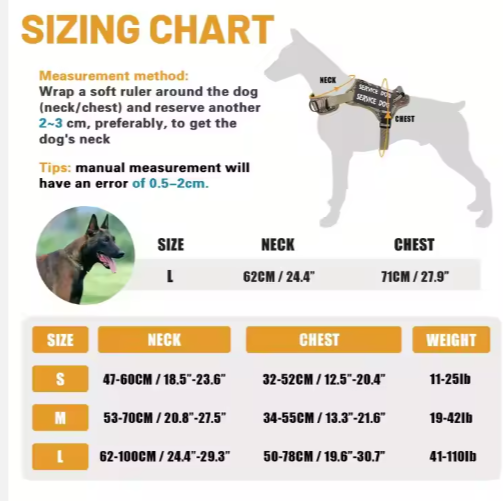
- Measure girth behind the front legs and chest depth; a service dog harness must sit behind the shoulder blades, not on the throat, with two fingers of clearance.
- Choose metal welded D-rings or V-rings for leash attachment; plastic D-rings fatigue and crack under repeated tension.
- Check handle attachment: the handle should be sewn to the harness's structural webbing, not to outer mesh or trim.
- For small service dogs, select a harness with a chest strap that adjusts down to the dog's girth; tactical one-size vests often start too large.
Specs
| Handle Anchor | Structural webbing, box-X stitched |
|---|---|
| D-Ring Material | Welded metal vs plastic |
| Adjustment Points | 4-point (neck, chest, girth) |
| Reflective Safety | 360° piping or panels |
Related searches
What to check before buying
- Girth measurement behind front legs plus chest depth—verify sizing chart matches your dog's dimensions, not just weight.
- Confirm the handle and D-ring are anchored to structural webbing with box-X stitching.
- Check reflective trim or panels for low-light public access.
- Verify patch attachment is removable and the vest is machine-washable or wipe-clean for hygiene.
FAQ
Data sources: eBay / Amazon listings and product attribute feeds. Updated Nov 28, 2026.
Some links on this page are affiliate links. If you buy after clicking one, we may earn a commission at no extra cost to you. This does not change which products appear here or their order. Affiliate disclosure.