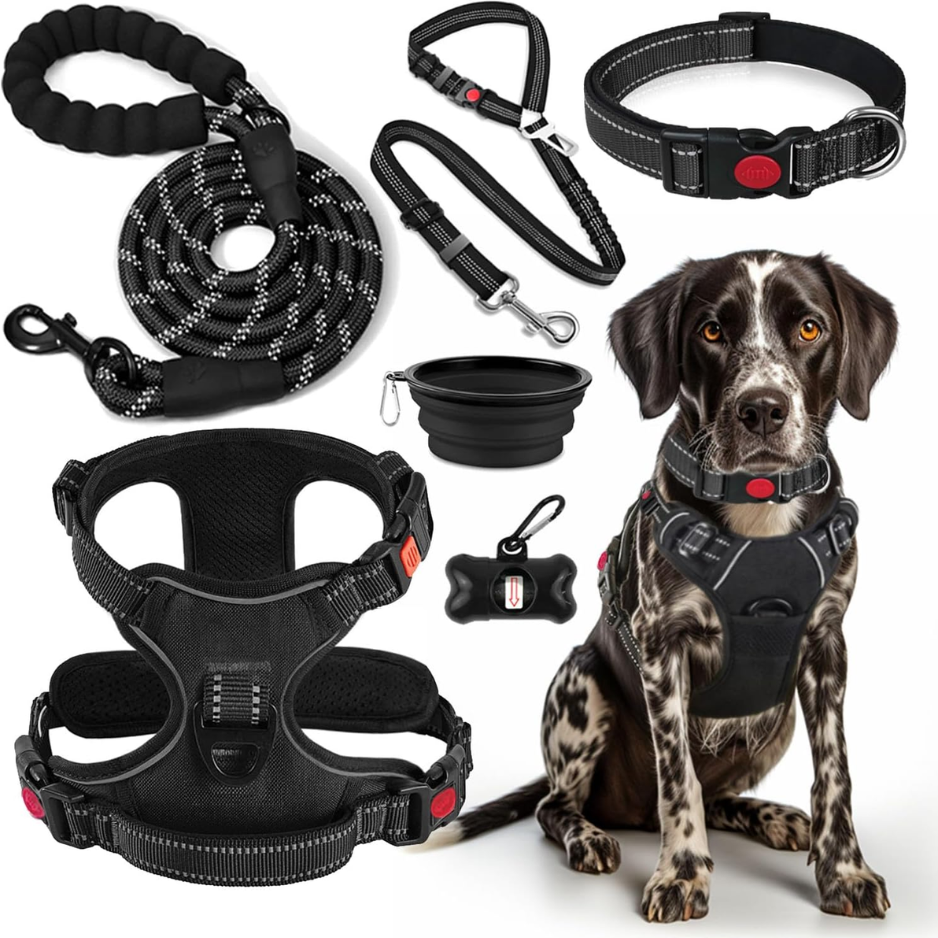

Photos from current listings. Actual item, color, and included accessories may vary.
No Pull Harness Buying Guide
A no-pull harness redirects forward momentum at the chest instead of the throat, using either a front-clip leverage point or a martingale-style tightening loop to discourage lunging. The core trade-off is between padding/breathability for daily comfort and structural webbing/stitching strength for strong pullers; flimsy mesh sets suit calm toy breeds, while wide nylon with metal D-rings and reinforced stitching is mandatory for determined medium-to-large dogs.
Key takeaways
- Front-clip designs turn the dog sideways when it pulls, while back-clip only stops choking—true no-pull control requires a front attachment point.
- Load-bearing webbing should be at least 1 inch (25 mm) wide for dogs over 30 lb, with box-X stitching at stress points and welded metal D-rings, not plastic.
- Mesh or cotton harnesses under 200 GSM suit dogs under 15 lb; heavier 600D–1000D Oxford nylon resists chewing and abrasion for strong pullers.
At a glance
- Category
- Pet Collars, Harnesses & Leashes
- Last updated
- Nov 28, 2026
Current offers
Highlights
- Front-clip designs turn the dog sideways when it pulls, while back-clip only stops choking—true no-pull control requires a front attachment point.
- Load-bearing webbing should be at least 1 inch (25 mm) wide for dogs over 30 lb, with box-X stitching at stress points and welded metal D-rings, not plastic.
- Mesh or cotton harnesses under 200 GSM suit dogs under 15 lb; heavier 600D–1000D Oxford nylon resists chewing and abrasion for strong pullers.
- Reflective piping and adjustable 4-point straps (neck + chest) are the key fit and safety differentiators on medium/large harnesses.
Best use cases
- Best for strong pullers (pitbulls, shepherds, huskies): pick a front-clip harness with 1–1.5 inch wide nylon, metal D-rings, and padded chest plate; skip thin mesh sets.
- Best for flat-faced or trachea-sensitive breeds (pugs, bulldogs): choose a Y-front or step-in harness that avoids neck pressure; skip collar-attached or choke-style leads.
- Best for small/toy breeds on calm walks: a lightweight mesh step-in set with matching leash is sufficient; skip heavy Oxford harnesses that chafe tiny frames.
- Wrong fit: back-clip-only harnesses for dogs that lunge—they stop choking but do nothing to reduce pulling force; pair with a front-clip or dual-attachment model instead.
Buying tips
- Measure chest girth at the widest point behind the front legs; add 2 fingers of slack—if between sizes, size up and tighten straps rather than downsizing.
- For dogs over 30 lb, insist on metal D-rings and box-X stitching; plastic buckles are the first failure point under load.
- Front-clip rings must sit on the chest, not the throat—check that the chest strap sits below the neck on a Y-front design.
- Match harness weight to climate: mesh for hot weather and short walks; padded Oxford for cold-weather or long hikes with strong pullers.
Specs
| Attachment Point | Front-clip vs back-clip vs dual |
|---|---|
| Webbing Width | 0.75–1.5 in (20–38 mm) |
| Hardware | Welded metal D-ring vs plastic |
| Adjustment Points | 2–4 (neck + chest) |
Related searches
What to check before buying
- Measure chest girth and neck circumference with a soft tape; compare to the harness size chart, not the dog's weight alone.
- Confirm the harness has both neck and chest adjustment straps—fixed-size harnesses slip on narrow-chested or deep-chested dogs.
- Check leash clip compatibility: a front D-ring needs a lightweight swivel snap; heavy brass snaps can twist and unclip on front rings.
- For reflective or nighttime use, verify the reflective trim is stitched or bonded, not printed, which peels after washing.
FAQ
Data sources: eBay / Amazon listings and product attribute feeds. Updated Nov 28, 2026.
Some links on this page are affiliate links. If you buy after clicking one, we may earn a commission at no extra cost to you. This does not change which products appear here or their order. Affiliate disclosure.