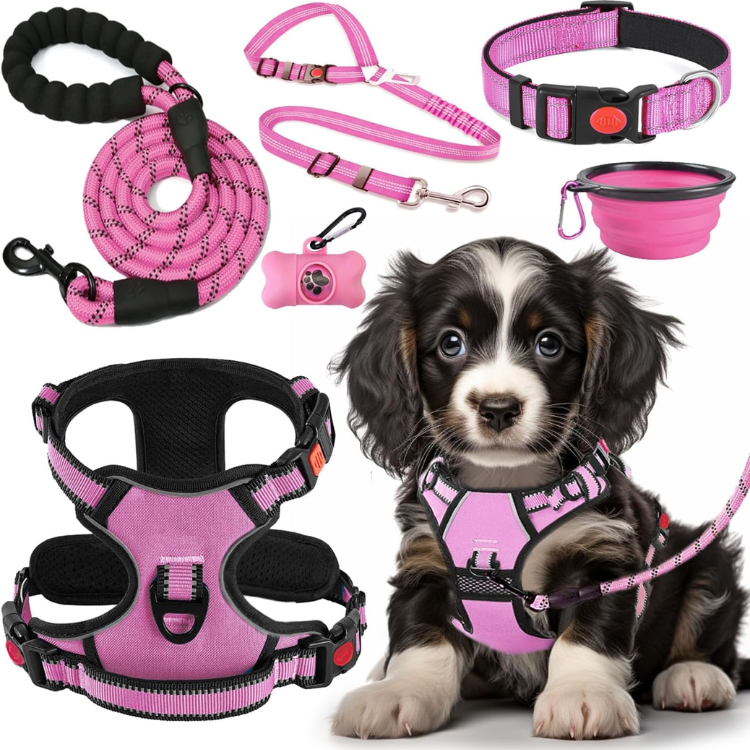

Photos from current listings. Actual item, color, and included accessories may vary.
Collar Harness And Leash Set Buying Guide
A collar, harness, and leash set bundles the three core walking essentials—often at a lower cost than buying separately—but the primary trade-off is construction quality: flimsy nylon webbing and plastic buckles versus reinforced stitching, metal hardware, and padded load-bearing panels. The decision rule is simple: buy a set only when the harness uses a no-pull front-clip or dual-clip design with welded metal rings and at least 1-inch-wide webbing for medium dogs; skip any set where the leash clip is the only metal part.
Median $88.49
Key takeaways
- No-pull harnesses route the leash at the chest (front-clip) to redirect forward motion, while back-clip only controls without discouraging pulling—front-clip is the functional upgrade.
- Webbing strength scales with width: 5/8-inch for toys and small breeds, 3/4-inch for small-medium, 1-inch for medium-large, and 1.5-inch for giant breeds; narrower webbing on a strong dog causes edge curl and stitch fatigue.
- Welded vs sewn D-rings: welded steel O-rings and D-rings resist pull loads above 200 lb, while plastic or split rings deform under sudden lunges—metal hardware is non-negotiable on the leash clip and harness attachment.
At a glance
- Category
- Pet Collars, Harnesses & Leashes
- Last updated
- Nov 28, 2026
Current offers
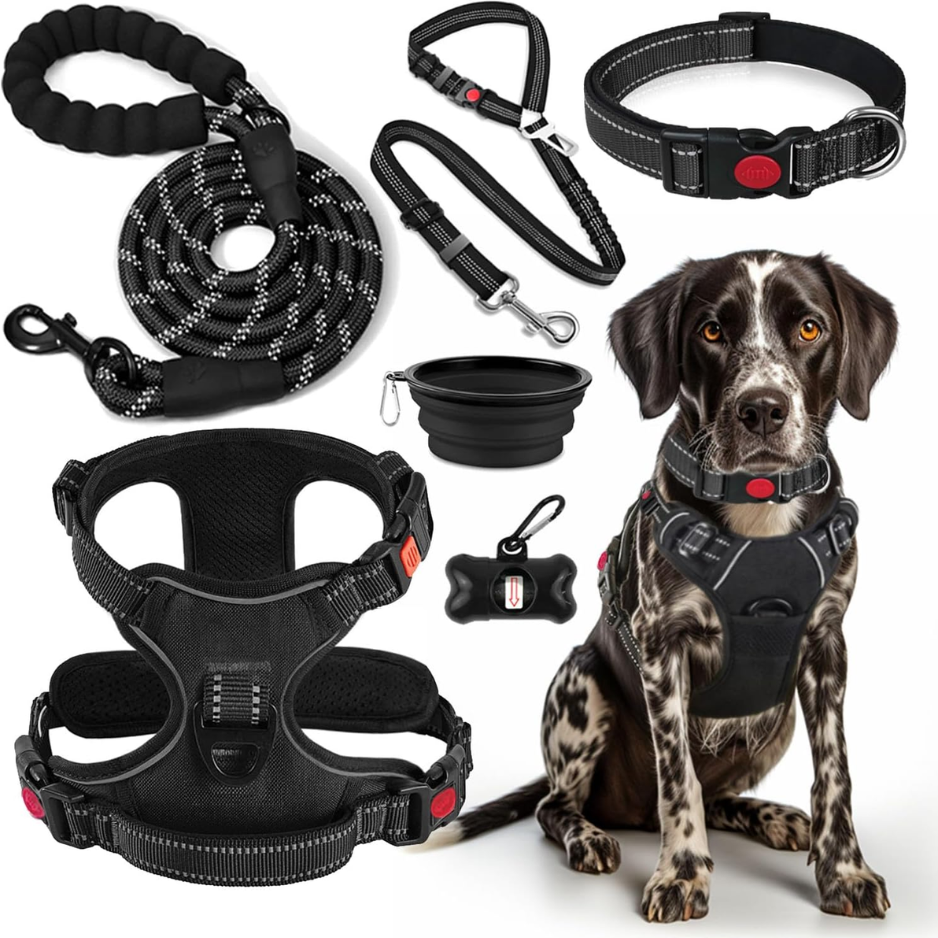
Highlights
- No-pull harnesses route the leash at the chest (front-clip) to redirect forward motion, while back-clip only controls without discouraging pulling—front-clip is the functional upgrade.
- Webbing strength scales with width: 5/8-inch for toys and small breeds, 3/4-inch for small-medium, 1-inch for medium-large, and 1.5-inch for giant breeds; narrower webbing on a strong dog causes edge curl and stitch fatigue.
- Welded vs sewn D-rings: welded steel O-rings and D-rings resist pull loads above 200 lb, while plastic or split rings deform under sudden lunges—metal hardware is non-negotiable on the leash clip and harness attachment.
- Adjustability points matter more than size labels: a quality set offers 4-5 adjustment sliders (neck, chest, girth) so the harness fits 2-inch girth ranges without gaping or rubbing.
Best use cases
- Best fit: daily neighborhood walks with a small-to-medium dog that pulls—choose a front-clip no-pull harness set with 3/4-inch webbing, padded chest plate, and a 5-foot leash with metal swivel clip.
- Best fit: travel and car rides—pick a set that includes a seatbelt tether and a short training leash, with quick-release buckles for fast on/off at rest stops.
- Wrong fit: strong large-breed pullers—skip thin-strap fashion sets with plastic buckles; choose 1-inch webbing, welded D-rings, and a harness rated for working dogs, or the set will fail at the seams.
- Wrong fit: flat-faced (brachycephalic) breeds—avoid step-in harnesses that press the throat; select a set with a Y-shaped front and adjustable neck opening that clears the trachea.
Buying tips
- Measure girth at the widest rib point, not the neck: add 2 inches for comfort, then match to the harness size chart—never buy by breed name alone.
- Check the leash clip: a zinc-alloy or stainless swivel snap with a 360-degree eye is the minimum; trigger clips with plastic bodies crack at the hinge under 50 lb of pull.
- Count the adjustment sliders: 4 or more points (2 neck, 2 chest) mean the harness can be fitted to a deep-chested or narrow dog; 2-point sets gap and chafe.
- Match webbing width to weight: under 15 lb use 5/8-inch, 15-40 lb use 3/4-inch, 40-80 lb use 1-inch, and over 80 lb use 1.5-inch—the leash should match or exceed harness width.
Specs
| Harness Style | No-pull front-clip / back-clip / step-in |
|---|---|
| Webbing Width | 5/8 in (small) to 1.5 in (giant) |
| Hardware | Welded steel rings / zinc-alloy clips |
| Leash Length | 4-6 ft standard walk / training |
Related searches
What to check before buying
- Measure the dog's girth (widest rib) and neck circumference with a soft tape; a set is only correct if both fall inside the harness's stated adjustment range.
- Confirm leash length and clip type: 5-foot is standard for walking, 6-foot for training, and a 4-foot traffic leash suits crowded sidewalks—verify the clip is metal, not plastic.
- Check the collar's buckle style: quick-release plastic buckles are fine for ID tags on calm dogs, but a martingale or metal-buckle collar is safer for escape artists.
- Verify the set includes matching hardware standards—same metal finish on D-rings, clips, and tags—because mixed platings corrode faster in rain and salt exposure.
FAQ
Data sources: eBay / Amazon listings and product attribute feeds. Updated Nov 28, 2026.
Some links on this page are affiliate links. If you buy after clicking one, we may earn a commission at no extra cost to you. This does not change which products appear here or their order. Affiliate disclosure.