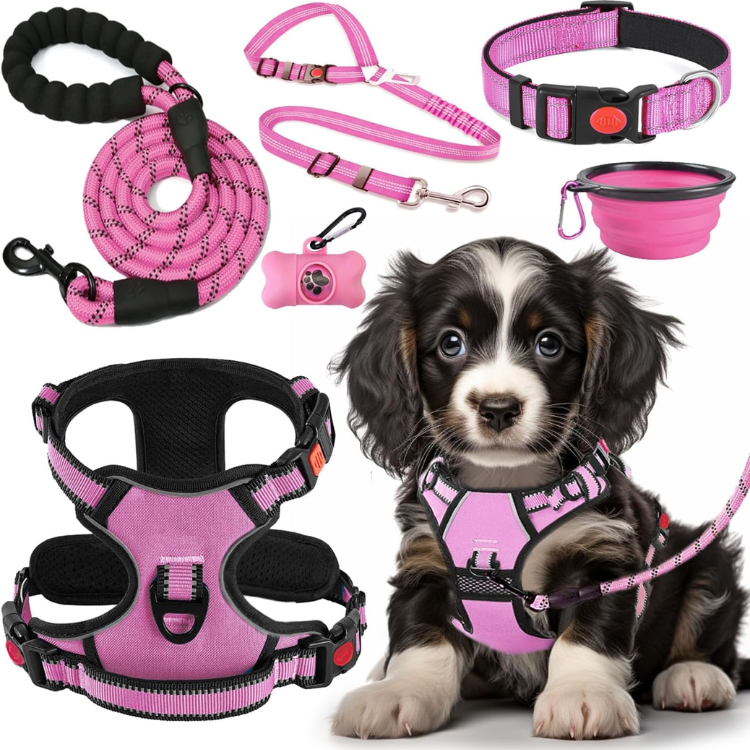

Photos from current listings. Actual item, color, and included accessories may vary.
10 No Pull Dog Harness Buying Guide
A no-pull dog harness redirects forward momentum away from the throat and into the chest or shoulders, using either a front-clip leash attachment or a martingale-style tightening loop to discourage lunging. The core trade-off is between a padded, multi-point adjustment harness that fits securely for daily walks and a thin, single-strap vest that chafes or allows elbow slip. Choose a harness with at least four adjustment points (neck, chest, and two shoulder straps) and a metal front D-ring if your dog pulls hard; skip any harness that relies on a single buckle or plastic load-bearing hardware.
Median $88.49
Key takeaways
- Front-clip no-pull geometry: a leash clipped to the chest D-ring turns the dog toward you when it pulls, while a back-clip only stops choking but does not reduce pulling force.
- Load-bearing hardware: welded stainless-steel D-rings and aluminum or steel buckles survive 200+ lb pull forces; plastic side-release buckles are the first failure point on budget harnesses.
- Padding and webbing: 1-inch-wide nylon webbing with neoprene or air-mesh lining distributes pressure across the sternum; narrow 5/8-inch straps cut into the armpit on strong pullers.
At a glance
- Category
- Pet Collars, Harnesses & Leashes
- Last updated
- Nov 28, 2026
Current offers
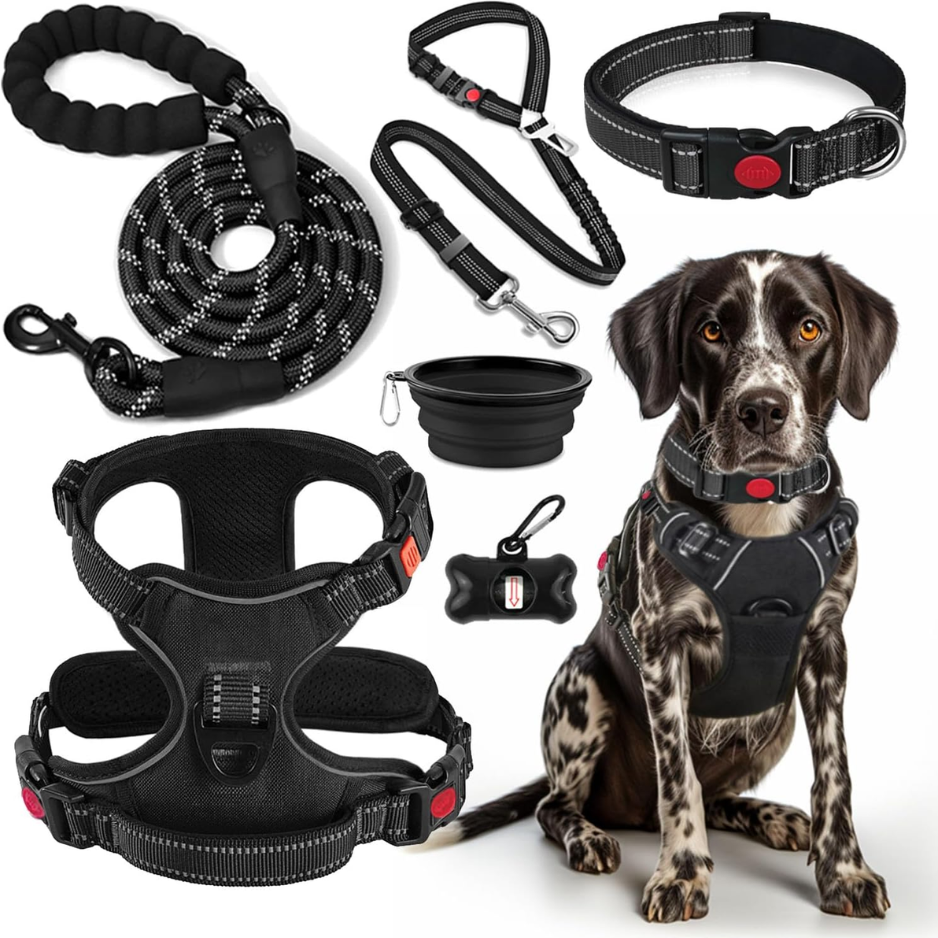
Highlights
- Front-clip no-pull geometry: a leash clipped to the chest D-ring turns the dog toward you when it pulls, while a back-clip only stops choking but does not reduce pulling force.
- Load-bearing hardware: welded stainless-steel D-rings and aluminum or steel buckles survive 200+ lb pull forces; plastic side-release buckles are the first failure point on budget harnesses.
- Padding and webbing: 1-inch-wide nylon webbing with neoprene or air-mesh lining distributes pressure across the sternum; narrow 5/8-inch straps cut into the armpit on strong pullers.
- Adjustment count: four or more slides (two at the neck, two at the chest) let you fit deep-chested or narrow dogs; two-adjustment harnesses either slip off shoulders or restrict front-leg reach.
Best use cases
- Best fit: strong pullers over 40 lb or dogs that lunge at squirrels—pick a front-clip harness with a martingale loop and metal buckles for control without throat pressure.
- Best fit: flat-faced breeds (pugs, bulldogs) or dogs with tracheal collapse—choose a Y-front or step-in harness that sits low on the chest and never crosses the throat.
- Wrong fit: dogs that back out of harnesses—skip step-in or single-belly-strap designs; pick a three-strap escape-proof harness with a locking neck buckle.
- Wrong fit: long-backed dogs (dachshunds, corgis)—avoid short-torso vest harnesses that rub the spine; choose an H-style harness with a longer back panel and adjustable girth.
Buying tips
- Measure girth at the widest part of the ribcage behind the front legs; add two fingers of slack—a harness sized exactly to girth will restrict breathing on hard pulls.
- For dogs 20–60 lb, use 1-inch webbing and a front D-ring rated for at least 2x body weight; for dogs over 60 lb, step up to 1.5-inch webbing and welded steel rings.
- Front-clip harnesses work best with a two-point leash (one clip on chest, one on back) to prevent the harness from twisting sideways during sudden lunges.
- Match the harness style to the pull type: front-clip for forward lunging, martingale loop for dogs that slip backward, and dual-clip for dogs that do both.
Specs
| Attachment Type | Front-clip D-ring / Back-clip / Dual |
|---|---|
| Hardware Material | Welded steel vs plastic buckles |
| Adjustment Points | 4+ (neck, chest, shoulders) |
| Webbing Width | 1 in (20–60 lb) / 1.5 in (60+ lb) |
Related searches
What to check before buying
- Girth measurement: wrap a soft tape behind the front legs at the widest rib point; compare to the harness size chart—do not size up for ‘growth’ on adult dogs.
- Neck opening: measure around the neck at the base of the skull; a harness that must be pulled over the head needs at least 2 inches of clearance over the ears.
- Hardware compatibility: confirm your leash snap (typically 3/4-inch or 1-inch) fits through the front D-ring without binding; bolt snaps are safer than trigger snaps on strong pullers.
- Climate and coat: for hot climates or double-coated breeds, choose a mesh-lined harness with no fleece padding; for cold-weather walks, size up one girth increment to fit over a coat.
FAQ
Data sources: eBay / Amazon listings and product attribute feeds. Updated Nov 28, 2026.
Some links on this page are affiliate links. If you buy after clicking one, we may earn a commission at no extra cost to you. This does not change which products appear here or their order. Affiliate disclosure.