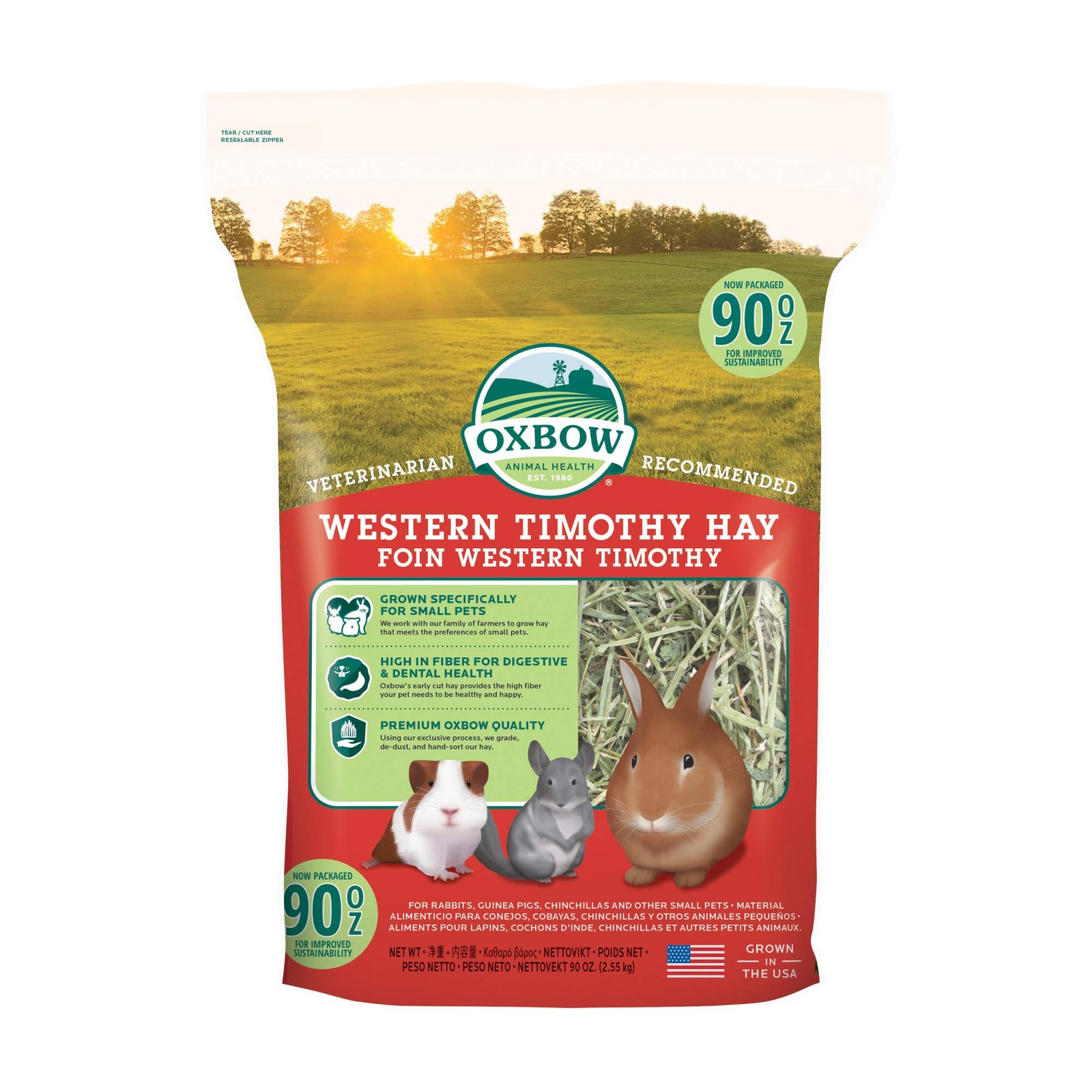

Photos from current listings. Actual item, color, and included accessories may vary.
Western Timothy Hay Buying Guide
Western Timothy hay is a grass hay (Phleum pratense) harvested in the western U.S., prized for its long, leafy strands and balanced calcium-to-phosphorus ratio for small herbivores. The core trade-off is cutting/grade versus steminess: first-cut hay is coarser and higher in fiber, while second- and third-cut hay is leafier and softer but lower in tooth-wearing fiber. The decision rule is simple: choose first-cut for dental wear and digestion in adult rabbits and guinea pigs, and second/third-cut only for young, senior, or dental-compromised animals that need softer forage.
Key takeaways
- Cutting number determines fiber and leaf ratio: first-cut is stem-heavy with high indigestible fiber, second/third-cut is leaf-dominant and softer.
- Oxbow Western Timothy is the benchmark retail standard: hand-sorted, dust-extracted, and sold in 40 oz, 90 oz, and 9 lb compressed bags.
- Long-strand hay (6–10 inch pieces) is essential—short chopped hay loses the figure-8 chewing motion that wears molars.
At a glance
- Category
- Bird & Small Animal Supplies
- Last updated
- Nov 27, 2026
Current offers
Highlights
- Cutting number determines fiber and leaf ratio: first-cut is stem-heavy with high indigestible fiber, second/third-cut is leaf-dominant and softer.
- Oxbow Western Timothy is the benchmark retail standard: hand-sorted, dust-extracted, and sold in 40 oz, 90 oz, and 9 lb compressed bags.
- Long-strand hay (6–10 inch pieces) is essential—short chopped hay loses the figure-8 chewing motion that wears molars.
- Western vs. Eastern Timothy: western-grown hay has higher altitude and lower humidity, producing leaner, less mold-prone stems.
Best use cases
- Best fit: adult rabbits (1–5 years) and guinea pigs—feed first-cut western Timothy as 70–80% of diet for molar wear and gut motility.
- Best fit: growing, pregnant, or nursing animals—offer second-cut western Timothy for higher protein and softer leaves.
- Wrong fit: animals under 7 months or with dental disease—skip coarse first-cut and choose soft third-cut or alfalfa-based transitional hay.
- Wrong fit: owners seeking a low-mess bedding replacement—hay is food, not bedding; use paper or wood pellets for absorbency instead.
Buying tips
- Buy by cutting: first-cut for adult dental health, second-cut for palatability, third-cut only for compromised chewers—never mix cuttings in one bag.
- Check strand length: look for 6–10 inch unchopped strands; bags with mostly short pieces (under 3 inches) fail to wear molars.
- Choose compressed bales (9 lb+) for multi-animal households; smaller 40–90 oz bags lose freshness faster after opening.
- Prefer hand-sorted, dust-extracted brands (Oxbow, Small Pet Select) over unlabeled farm bales, which often contain weeds and mold.
Specs
| Cutting | First / Second / Third cut |
|---|---|
| Strand Length | 6–10 in long-strand vs short chopped |
| Species Fit | Rabbits, guinea pigs, chinchillas |
| Pack Size | 40 oz / 90 oz / 9 lb compressed |
Related searches
What to check before buying
- Measure storage: a 9 lb compressed bale expands to roughly 2–3 cubic feet—confirm a dry, ventilated bin or closet space.
- Match hay to species: guinea pigs need unlimited Timothy; rabbits need a hay rack that holds at least a 2-day supply.
- Verify allergen control: if household members have grass allergies, choose dust-extracted hay and store away from living areas.
- Confirm supply cycle: hay loses vitamin A after 6–8 months—buy only what two animals can finish in 3–4 months.
FAQ
Data sources: eBay / Amazon listings and product attribute feeds. Updated Nov 27, 2026.
Some links on this page are affiliate links. If you buy after clicking one, we may earn a commission at no extra cost to you. This does not change which products appear here or their order. Affiliate disclosure.