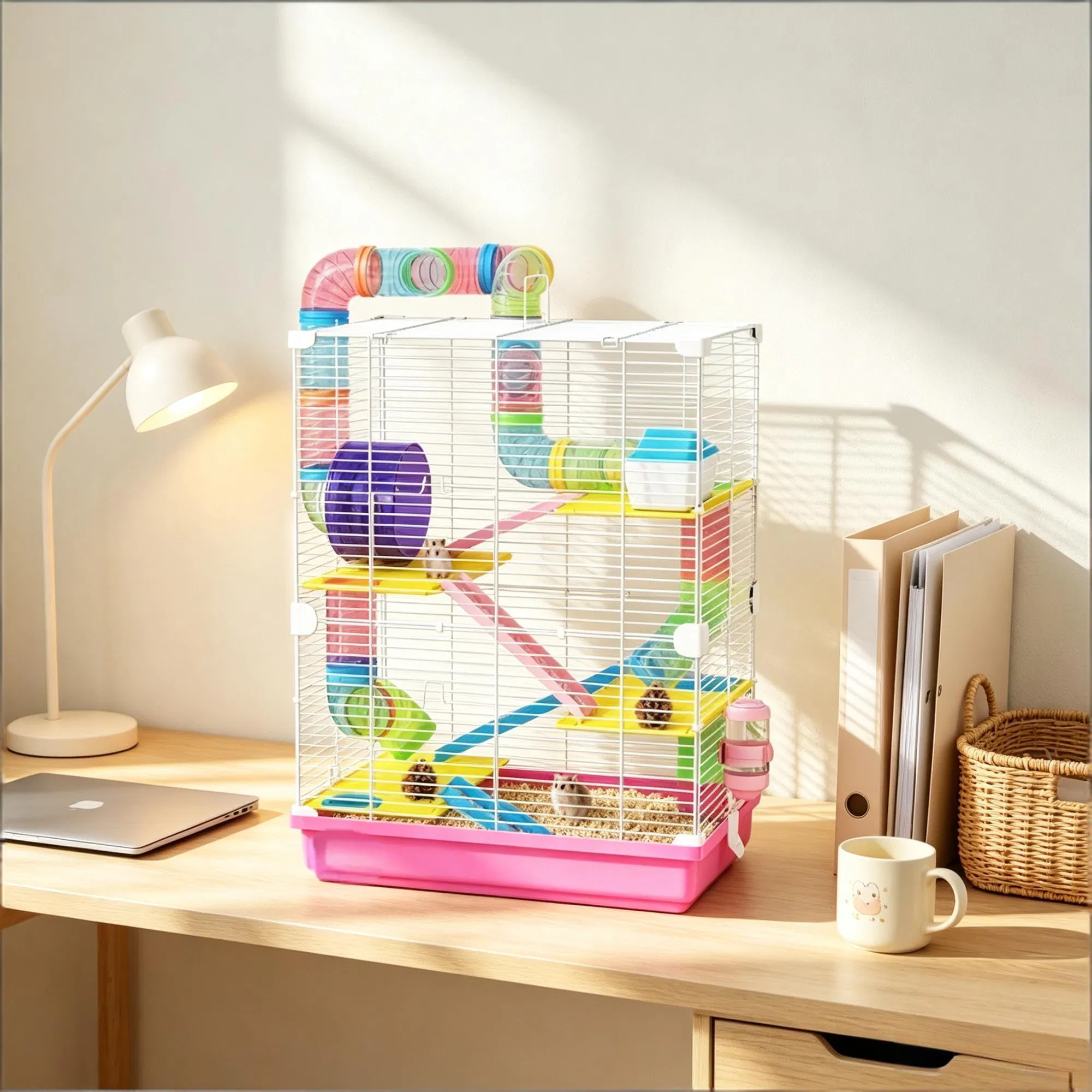

Photos from current listings. Actual item, color, and included accessories may vary.
Small Animal Travel Cage Buying Guide
A small animal travel cage is a temporary, transport-safe enclosure for hamsters, guinea pigs, rabbits, rats, and similar pets, distinct from permanent habitats. The core trade-off is between portability/ventilation and escape-proof security under stress: thin wire bars, snap-fit latches, and untreated wood or soft fabric sides fail quickly, while welded wire, metal latches, and chew-resistant solid panels hold up. The decision rule is simple: buy a cage with a locking metal door, bar spacing matched to your species, and a solid leak-resistant base—skip any fabric carrier or lightweight plastic tiered unit with friction-fit lids for a determined chewer.
Key takeaways
- Bar spacing is the primary security spec: 1 cm (3/8 in) or less for hamsters and mice, 1.5–2 cm (5/8–3/4 in) for rats, and 2.5–3 cm (1–1.2 in) for guinea pigs and rabbits; larger gaps allow head or limb entrapment.
- Welded 12–14 gauge wire with a powder coating resists bending and chewing far better than brazed or electroplated mesh; 2 mm wire diameter is the practical floor for rabbit and guinea pig travel use.
- Secure latching matters more than wall thickness on the road: a sliding or twist metal latch on the main door plus secondary clips at panel joints prevents stress-induced escapes, unlike friction-fit or snap plastic lids.
At a glance
- Category
- Bird & Small Animal Supplies
- Last updated
- Nov 27, 2026
Current offers
Highlights
- Bar spacing is the primary security spec: 1 cm (3/8 in) or less for hamsters and mice, 1.5–2 cm (5/8–3/4 in) for rats, and 2.5–3 cm (1–1.2 in) for guinea pigs and rabbits; larger gaps allow head or limb entrapment.
- Welded 12–14 gauge wire with a powder coating resists bending and chewing far better than brazed or electroplated mesh; 2 mm wire diameter is the practical floor for rabbit and guinea pig travel use.
- Secure latching matters more than wall thickness on the road: a sliding or twist metal latch on the main door plus secondary clips at panel joints prevents stress-induced escapes, unlike friction-fit or snap plastic lids.
- Solid, leak-resistant base trays in ABS or PP at 3–5 mm thickness with a raised lip contain spills and urine during car motion; untreated wood or thin vacuum-formed trays absorb odor and crack at stress points.
Best use cases
- Best fit: short vet trips and car rides for a single hamster or rat—pick a compact wire cage with bar spacing ≤1.5 cm, a metal twist latch, and a removable solid base; skip tiered plastic tubes that pop apart under vibration.
- Best fit: multi-day travel or temporary housing for guinea pigs or rabbits—choose a larger wire cage (minimum 60×40 cm floor for one guinea pig, 75×45 cm for one rabbit) with 2.5–3 cm bar spacing and a solid base; skip fabric soft carriers entirely.
- Wrong fit: leaving any small animal in a travel cage as a permanent habitat—these units lack the continuous floor area, depth for bedding, and wheel clearance that permanent cages require; use travel cages only for transit or brief isolation.
- Best fit: air travel or train travel—select a hard-sided plastic carrier that meets airline under-seat dimensions with metal ventilation grilles on at least three sides; skip open wire cages, which most carriers reject.
Buying tips
- Measure your pet's head width and match bar spacing below that figure: hamsters need ≤1 cm, rats ≤2 cm, guinea pigs and rabbits ≤3 cm; a gap wider than the skull invites entrapment.
- Size the floor for the journey, not the species maximum: a single guinea pig needs at least 60×40 cm in transit, a single rabbit 75×45 cm, and two same-species pets roughly 1.5× that floor area.
- Choose metal latches over plastic snaps and add zip ties or carabiners at panel joints for road trips; vibration is the leading cause of joint separation and escape in modular travel cages.
- Prefer ABS or PP base trays at 3–5 mm with a 2–3 cm raised lip; avoid untreated wood bases, which absorb urine, swell, and harbor odor within a few trips.
Specs
| Bar Spacing | ≤1 cm hamster / ≤2 cm rat / ≤3 cm rabbit |
|---|---|
| Wire Gauge | 12–14 gauge welded, powder-coated |
| Base Tray | ABS/PP, 3–5 mm, 2–3 cm lip |
| Door Latch | Metal twist or sliding latch |
Related searches
What to check before buying
- Measure your car seat or carrier space and confirm the assembled cage footprint plus 10 cm clearance fits before purchase; travel cages are returned most often for being too large for the vehicle.
- Confirm the bar spacing matches your species (≤1 cm hamster/mouse, ≤2 cm rat, ≤3 cm guinea pig/rabbit) and that the main door has a metal, not plastic, latch.
- Check the base tray material and lip height—ABS/PP at 3–5 mm with a 2–3 cm lip—and verify it locks to the wire body rather than resting loosely.
- For air or rail travel, confirm the carrier's dimensions meet the operator's under-seat or baggage spec and that ventilation grilles are metal, not molded plastic slots.
FAQ
Data sources: eBay / Amazon listings and product attribute feeds. Updated Nov 27, 2026.
Some links on this page are affiliate links. If you buy after clicking one, we may earn a commission at no extra cost to you. This does not change which products appear here or their order. Affiliate disclosure.