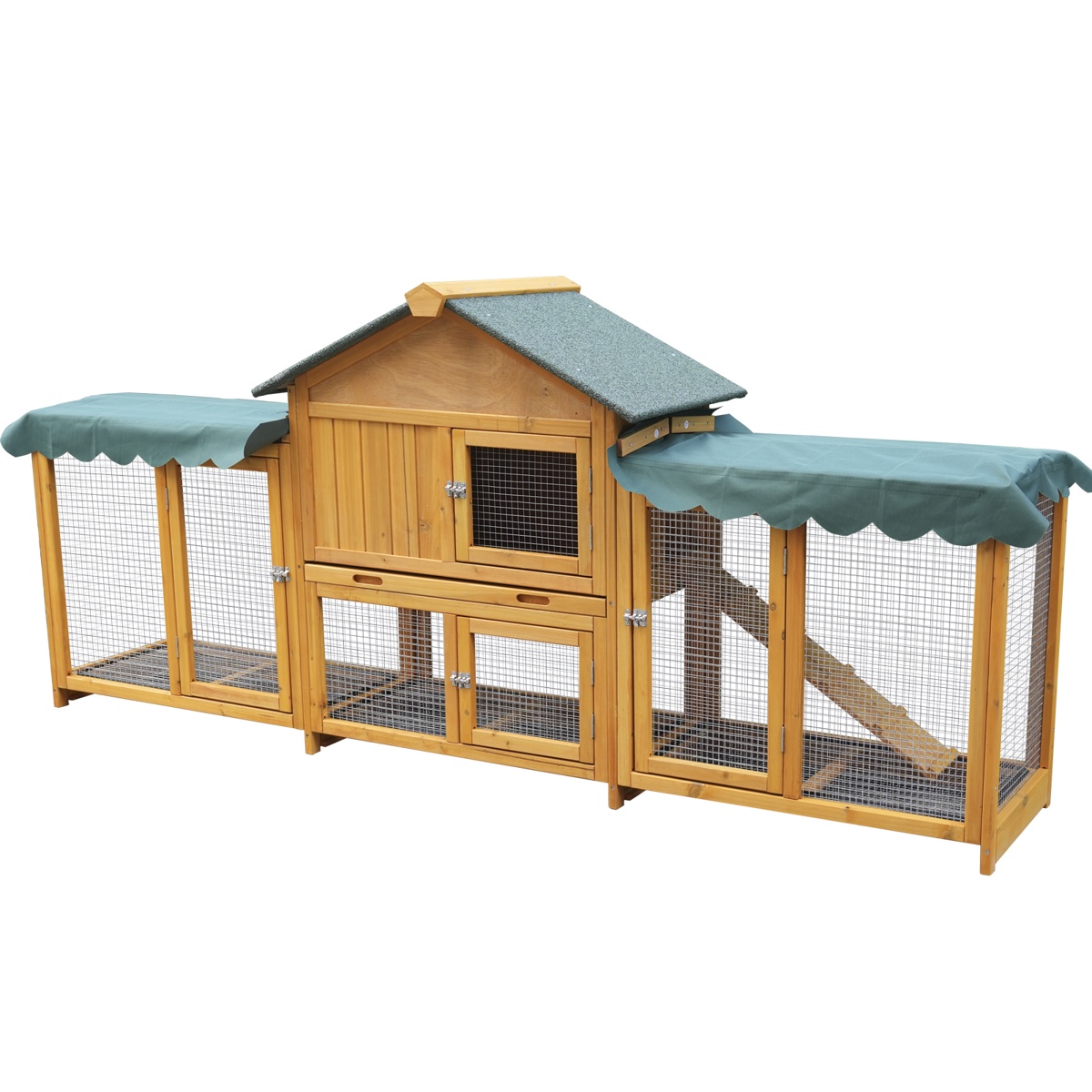

Photos from current listings. Actual item, color, and included accessories may vary.
Large Indoor Rabbit Cage Buying Guide
Large indoor rabbit cages are stationary habitats sized for a rabbit to stand fully upright, stretch, and take several uninterrupted hops, typically built from wood, coated wire, or a wood-metal hybrid. The core trade-off is floor footprint and bar-spacing safety versus tray access, ventilation, and weather protection; budget hutches often shrink height and use thin 8–10 mm plywood, while durable enclosures use thicker timber, rust-coated wire, and fully removable metal trays. Buy the largest footprint your room can clear, with 1-inch bar spacing and a solid resting surface, and skip any hutch that forces a hunching posture or uses untreated softwood.
Key takeaways
- Bar spacing of 1 inch (2.5 cm) or less prevents escape and head entrapment; wider wire gaps let small and juvenile rabbits squeeze through or catch limbs.
- Rabbit posture math: a medium breed needs at least 24 inches of internal height to stand on hind legs without ear contact, and 36 inches of continuous floor length for three hops.
- Wood-metal hybrids pair an asphalt or water-resistant roof and slide-out metal tray with coated wire panels; all-wood hutches retain urine odor unless the tray is metal or fully removable.
At a glance
- Category
- Bird & Small Animal Supplies
- Last updated
- Nov 27, 2026
Current offers
Highlights
- Bar spacing of 1 inch (2.5 cm) or less prevents escape and head entrapment; wider wire gaps let small and juvenile rabbits squeeze through or catch limbs.
- Rabbit posture math: a medium breed needs at least 24 inches of internal height to stand on hind legs without ear contact, and 36 inches of continuous floor length for three hops.
- Wood-metal hybrids pair an asphalt or water-resistant roof and slide-out metal tray with coated wire panels; all-wood hutches retain urine odor unless the tray is metal or fully removable.
- Two-story models add ramp-accessed upper decks for vertical enrichment, but the lower level must still meet the full footprint minimum since ramps do not replace floor area.
Best use cases
- Best fit: a single medium rabbit in a supervised indoor room — pick a 48-inch-long, 24-inch-high wood-metal hutch with a slide-out metal tray and lockable door for daily cleaning and predator-proofing.
- Best fit: a bonded pair or a rabbit needing vertical space — choose a 54-inch two-story model with a ramp and a no-leak tray, but confirm each level is at least 24 inches tall.
- Wrong fit: an apartment with limited floor clearance — a two-story 54-inch hutch still occupies a 4.5-foot footprint; skip it for a smaller footprint only if the rabbit gets daily free-roam time.
- Wrong fit: full-time outdoor use — indoor hutches with thin roofs and untreated wood degrade; for year-round outdoors, pick a weatherproof model with raised feet and an asphalt roof instead.
Buying tips
- Measure the rabbit nose-to-tail and multiply by at least 4 for length and 2 for width; a 20-inch rabbit needs roughly 80 inches of length in a full-time enclosure, or 48 inches with daily exercise.
- Check internal height, not exterior: subtract 2–3 inches for roof and tray framing; a listed 36-inch exterior height typically yields about 30–32 inches inside, enough for medium breeds to stand.
- Choose galvanized or powder-coated wire over bare wire; urine is acidic and corrodes untreated mesh within a season, weakening welds and creating sharp edges.
- Prefer slide-out trays made of metal with rounded corners; plastic trays crack under UV and absorb odor, while wood floors without trays become urine-soaked and unrecoverable.
Specs
| Bar Spacing | 1 in (2.5 cm) max |
|---|---|
| Min Floor Footprint | 48 x 24 in (12 sq ft) |
| Internal Height | 24–32 in standing clearance |
| Tray & Roof Build | Metal slide-out / asphalt roof |
Related searches
What to check before buying
- Clear floor space: tape out the exterior footprint (e.g., 48 x 25 inches or 82 x 30 inches for extra-large) plus 6 inches of clearance on the door side before ordering.
- Room climate and floor: indoor hutches belong on hard, level flooring away from direct sun and drafts; asphalt roofs are for outdoor use and add weight and height indoors.
- Doorway and stair width: assembled hutches 48–82 inches long and 36 inches tall may not fit through interior doors or up stairwells; confirm the largest panel dimension against your tightest passage.
- Companion parts: a solid resting mat or hide box for the wire floor, a corner litter pan, and bowl/bottle mounts; wire floors without a mat cause sore hocks.
FAQ
Data sources: eBay / Amazon listings and product attribute feeds. Updated Nov 27, 2026.
Some links on this page are affiliate links. If you buy after clicking one, we may earn a commission at no extra cost to you. This does not change which products appear here or their order. Affiliate disclosure.