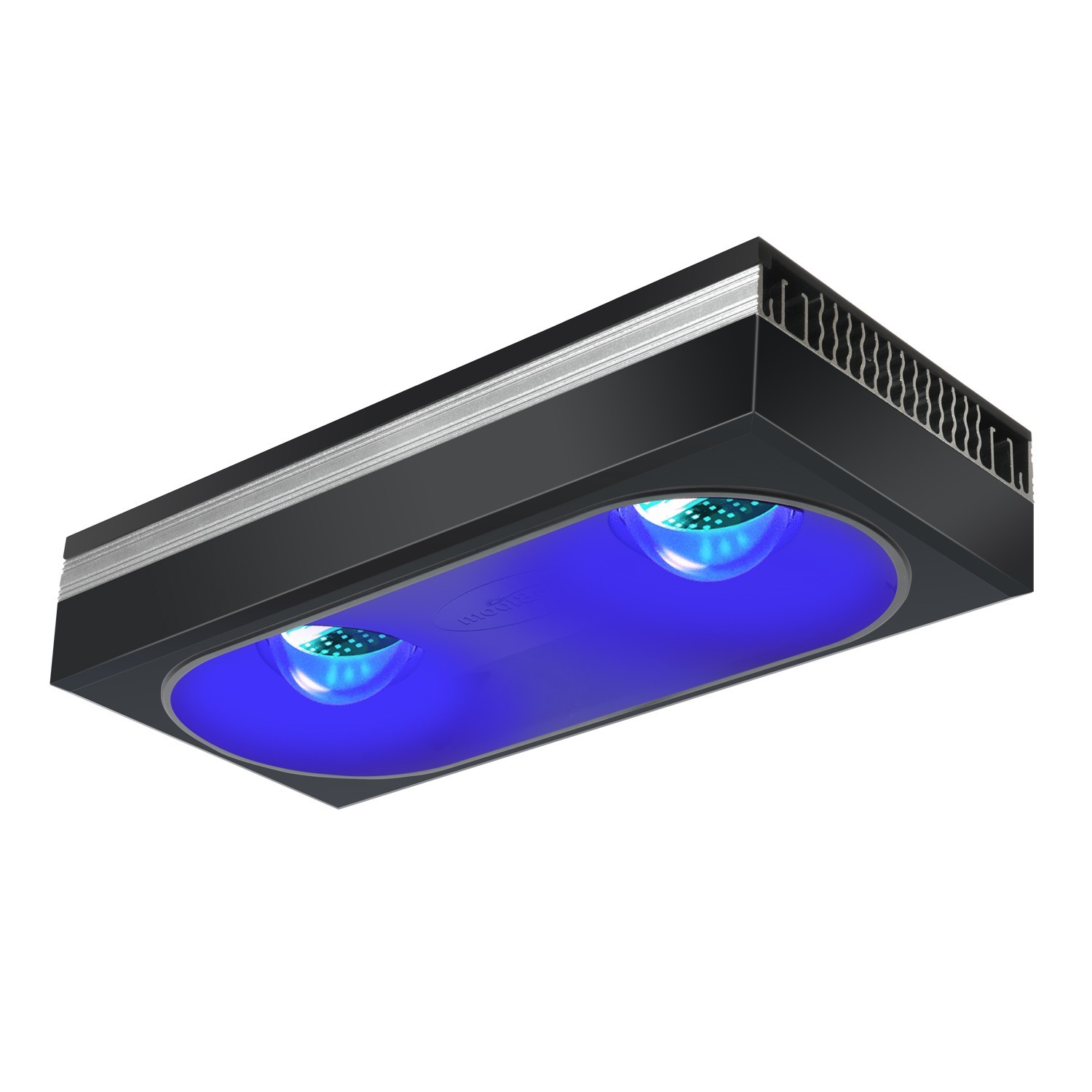

Photos from current listings. Actual item, color, and included accessories may vary.
Saltwater Aquarium LED Light Buying Guide
Saltwater aquarium LED lights are high-intensity, spectrum-tuned fixtures built to sustain photosymbiotic corals and marine invertebrates, not just illuminate fish. The core trade-off is spectrum quality and PAR spread versus heat management and controllability: cheap units often use low-bin diodes with narrow blue peaks and weak passive cooling, while durable reef-grade fixtures pair full-spectrum multi-channel LEDs with active thermal design and proven water-resistance. Choose a fixture with measurable PAR at your tank depth, a true reef spectrum (violet through deep red), and IP-rated housing if you keep light over open water; skip generic 'aquarium blue/white' strips that cannot sustain corals.
Key takeaways
- Reef-grade LED arrays use multi-channel control (violet, royal blue, cool white, warm white, red, green) to hit the chlorophyll absorption peaks corals need; single-color blue/white fixtures cannot tune spectrum.
- PAR at depth is the deciding metric: a 90W fixture over a 24-inch-deep tank delivers far less usable PAR at the sandbed than the same wattage over 12 inches; wattage alone does not predict coral growth.
- Passive aluminum heatsinks with fin area versus active fan cooling determines LED lifespan and output stability; fan-cooled units sustain higher output without diode degradation.
At a glance
- Category
- Aquarium Lights & CO2 Systems
- Last updated
- Nov 25, 2026
Current offers
Highlights
- Reef-grade LED arrays use multi-channel control (violet, royal blue, cool white, warm white, red, green) to hit the chlorophyll absorption peaks corals need; single-color blue/white fixtures cannot tune spectrum.
- PAR at depth is the deciding metric: a 90W fixture over a 24-inch-deep tank delivers far less usable PAR at the sandbed than the same wattage over 12 inches; wattage alone does not predict coral growth.
- Passive aluminum heatsinks with fin area versus active fan cooling determines LED lifespan and output stability; fan-cooled units sustain higher output without diode degradation.
- IP65 or better splash-rated housings and sealed cable entry separate durable reef fixtures from open-frame units that corrode quickly in salt creep.
Best use cases
- Best fit: mixed-reef or LPS-dominant tanks 24–36 inches long and up to 24 inches deep — pick a 90W-class multi-channel fixture with programmable ramp timers; skip high-wattage narrow-optics units that hotspot soft corals.
- Best fit: SPS-dominant or deep tanks over 24 inches — choose a higher-output (180W-class) fixture with wide 120-degree optics and active cooling, or plan two units; skip single low-power bars.
- Wrong fit: fish-only saltwater tanks with no corals — a basic blue/white LED bar is adequate and cheaper; do not pay for reef spectrum and PAR you do not need.
- Wrong fit: nano tanks under 10 gallons — full-size 90W+ reef fixtures bleach corals and overheat small volumes; pick a dimmable low-wattage nano fixture instead.
Buying tips
- Match LED wattage to tank depth and coral type: roughly 3–5W per gallon for soft/LPS, 5–8W per gallon for SPS, and derate for tanks deeper than 24 inches where PAR drops sharply.
- Choose fixtures with 0–10V, PWM, or app/WiFi dimming and at least 6 channels; fixed-spectrum units lock you out of acclimation and coral color tuning.
- Verify diode bin quality and lens angle: 120-degree lenses give better spread and less hotspotting than 60–90-degree narrow optics in most home reef tanks.
- Confirm the fixture's mounting standard (tank rim clamp, hanging kit, or rail) matches your tank length and canopy before purchase; mismatched mounts are the most common return reason.
Specs
| LED Spectrum | Multi-channel reef (violet-red) |
|---|---|
| Wattage Class | 90W / 180W reef tiers |
| Dimming Control | App/WiFi or 0-10V PWM |
| Housing Rating | IP65+ splash-resistant |
Related searches
What to check before buying
- Measure tank length, width, and water depth; a single fixture typically covers 24 inches of length, so tanks 48 inches or wider need two units for even PAR.
- Check canopy or rim clearance: clamp mounts need 0.5–1 inch of rim thickness, and hanging kits need ceiling or wall anchor points above the tank.
- Confirm your home voltage (120V North America vs 230V EU/UK) and plug type; many reef LEDs ship with region-specific power supplies.
- Plan controller compatibility: WiFi/app fixtures need 2.4GHz networks, and some units require a separate controller or hub for scheduling and dimming.
FAQ
Data sources: eBay / Amazon listings and product attribute feeds. Updated Nov 25, 2026.
Some links on this page are affiliate links. If you buy after clicking one, we may earn a commission at no extra cost to you. This does not change which products appear here or their order. Affiliate disclosure.