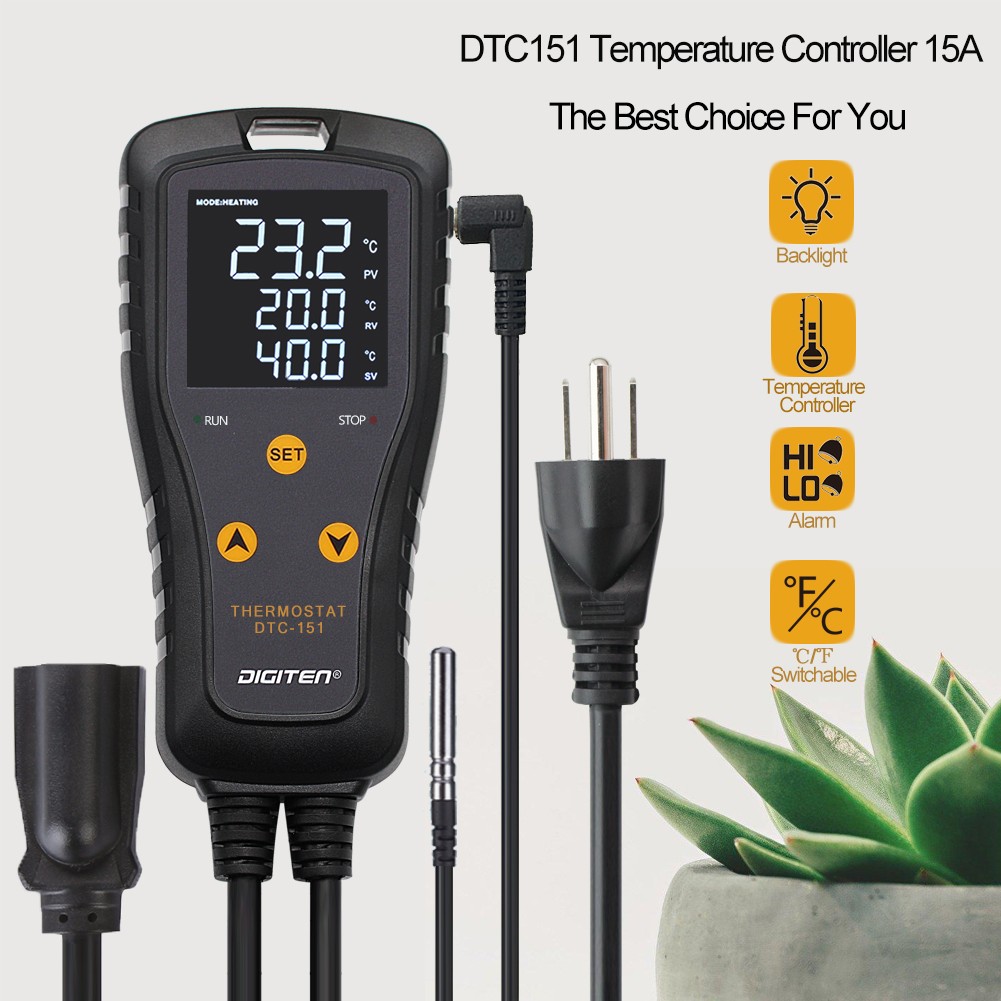

Photos from current listings. Actual item, color, and included accessories may vary.
DIGITEN DTC151 Buying Guide
The DIGITEN DTC151 is a single-channel digital temperature controller with a 15A relay and a waterproof NTC probe, used to switch heat mats or ceramic bulbs for reptile vivariums. The core trade-off is simple on/off hysteresis control versus proportional (pulse) regulation: the DTC151 is a hard-switching thermostat, so it is best treated as a reliable budget heat source controller, not a precision incubator or dimming thermostat. The decision rule: buy it only if you need on/off control of a 15A-rated load and accept a 1°C switching band with no day/night ramping.
Key takeaways
- 15A relay rating switches resistive loads up to about 1800W at 120V or 3450W at 230V; inductive loads like some pumps derate heavily.
- Included NTC probe is waterproof to the cable jacket, not the connector, so keep the plug end outside the enclosure or above the waterline.
- Control is single-setpoint on/off with adjustable hysteresis; there is no pulse-proportional or dimming output, so ceramic bulbs and CHEs cycle fully on and off.
At a glance
- Category
- Reptile Thermostats & Monitoring
- Status
- Listings available
- Last updated
- Nov 23, 2026
Current offers
Highlights
- 15A relay rating switches resistive loads up to about 1800W at 120V or 3450W at 230V; inductive loads like some pumps derate heavily.
- Included NTC probe is waterproof to the cable jacket, not the connector, so keep the plug end outside the enclosure or above the waterline.
- Control is single-setpoint on/off with adjustable hysteresis; there is no pulse-proportional or dimming output, so ceramic bulbs and CHEs cycle fully on and off.
- The controller itself is not a thermostat housing and has no fused output; it relies on the connected heat device's own safety limits.
Best use cases
- Best fit: a single heat mat or ceramic heat emitter in a glass vivarium where a 15A on/off controller at a fixed setpoint is all the regulation you need.
- Best fit: a backup or emergency thermostat when a primary proportional controller fails, because the DTC151 accepts 15A directly without a relay box.
- Wrong fit: incubators, egg boxes, or any setup needing ±0.1°C stability — use a proportional/pulse thermostat instead.
- Wrong fit: multi-zone racks (each shelf needs its own heat source control); a single-probe single-relay unit cannot balance two zones.
Buying tips
- Choose the 12V/24V variant only if your heat source is DC; the 120V/230V mains models are separate SKUs and are not interchangeable.
- Match total heat load to 80% of the 15A rating: at 120V keep continuous draw under about 12A (~1440W); at 230V under ~12A (~2760W).
- Confirm the probe type is NTC 10kΩ; the DTC151 is calibrated for its included NTC probe, and a mismatched thermocouple will read wrong.
- Use the hysteresis setting to widen the switching band if the relay chatters; a 1–2°C band trades stability for longer relay life.
Specs
| Control Type | Single-setpoint on/off, adjustable hysteresis |
|---|---|
| Relay Rating | 15A resistive, single channel |
| Probe Type | NTC 10kΩ waterproof, fixed cable |
| Voltage Variants | 120V / 230V AC, plus 12V/24V DC |
Related searches
What to check before buying
- Measure the vivarium's heat source total wattage and confirm it stays within 80% of the 15A relay rating at your mains voltage.
- Check the probe cable length reaches from the controller to the basking spot without tension; keep the plug connector outside the enclosure.
- Verify your heat device is a simple resistive on/off load (mat, CHE, bulb) and not a dimmable panel or multi-stage unit.
- Plan a second independent thermostat as a safety cutout for high-wattage ceramic emitters, since the DTC151 has no fused output.
FAQ
Data sources: eBay / Amazon listings and product attribute feeds. Updated Nov 23, 2026.
Some links on this page are affiliate links. If you buy after clicking one, we may earn a commission at no extra cost to you. This does not change which products appear here or their order. Affiliate disclosure.