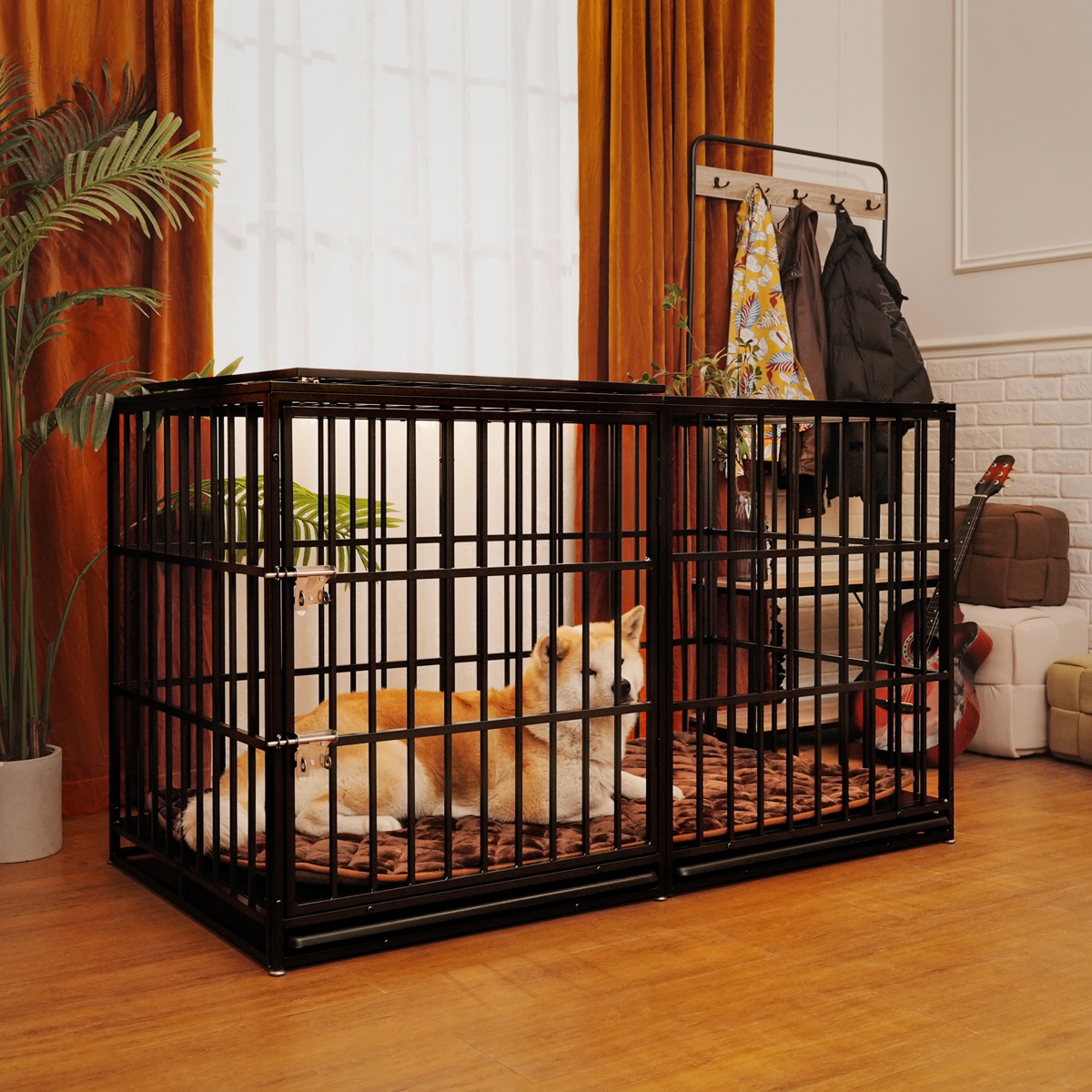

Photos from current listings. Actual item, color, and included accessories may vary.
Strong Dog Cage Large Buying Guide
Buyers searching for a strong large dog cage are usually replacing a flimsy wire crate that bent, escaped, or failed under a determined dog. The critical variables are weld quality, bar gauge, latch design, and whether the crate is built for containment or only for house training. Get the frame and latch tier right first; cosmetic features and included mats are secondary.
Key takeaways
- Heavy-duty large crates typically use 8- to 10-gauge welded wire with reinforced corner gussets, versus 12- to 14-gauge wire on standard training crates that dogs can bend.
- Escape-resistant latches use dual or triple slide bolts with rounded safety heads; single friction latches are the most common failure point on large, strong dogs.
- Two-door designs (front plus side) improve access in tight rooms and let you position the crate against a wall without losing entry; single-door crates limit placement.
At a glance
- Category
- Pet Crates, Kennels & Playpens
- Last updated
- Nov 28, 2026
Current offers
Highlights
- Heavy-duty large crates typically use 8- to 10-gauge welded wire with reinforced corner gussets, versus 12- to 14-gauge wire on standard training crates that dogs can bend.
- Escape-resistant latches use dual or triple slide bolts with rounded safety heads; single friction latches are the most common failure point on large, strong dogs.
- Two-door designs (front plus side) improve access in tight rooms and let you position the crate against a wall without losing entry; single-door crates limit placement.
- Large crates generally measure 42 to 48 inches long and 28 to 32 inches tall, fitting dogs roughly 70 to 110 pounds; giant breeds need 54-inch models.
Best use cases
- Best fit: a 70- to 90-pound dog that has bent wire crates or slipped latches — choose a 42- to 48-inch heavy-duty welded crate with dual slide bolts and reinforced corners.
- Best fit: crate training in a tight bedroom or against a wall — pick a two-door model so the side door remains usable when the front is blocked.
- Wrong fit: a puppy or calm small breed — a standard 12- to 14-gauge wire crate at the correct size is lighter, cheaper, and easier to move.
- Wrong fit: a dog with severe separation anxiety or confirmed escape history — a strong wire cage is still a cage; choose a rotationally molded impact crate instead.
Buying tips
- Size by interior floor length: the dog should stand, turn, and lie fully stretched, which means body length plus 2 to 4 inches and height plus 2 to 4 inches.
- Prioritize 8- to 10-gauge wire and fully welded joints at stress points; spot-welded corners on thin wire are the first thing a strong dog breaks.
- Inspect latch hardware for dual slide bolts with safety heads rather than a single friction latch or a simple hook-and-eye.
- Compare door count and placement to your room layout; a two-door crate costs more but prevents forcing a one-door crate into a bad spot.
Specs
| Wire Gauge | 8-10 ga heavy-duty vs 12-14 ga standard |
|---|---|
| Large Crate Length | 42-48 in (70-110 lb dogs) |
| Latch Type | Dual slide bolts vs single friction latch |
| Door Configuration | Single front vs two-door (front + side) |
Related searches
What to check before buying
- Measure your dog standing and lying down, then compare against the crate's interior dimensions — not the exterior footprint.
- Measure doorways and stair width along the delivery path; a 48-inch assembled crate often will not fit through a standard interior door.
- Confirm the crate ships with a floor pan or tray and that replacement trays are available in the same size.
- Check floor protection: heavy crates need rubber feet or a mat on hardwood and tile to prevent scratching and sliding.
FAQ
Data sources: eBay / Amazon listings and product attribute feeds. Updated Nov 28, 2026.
Some links on this page are affiliate links. If you buy after clicking one, we may earn a commission at no extra cost to you. This does not change which products appear here or their order. Affiliate disclosure.