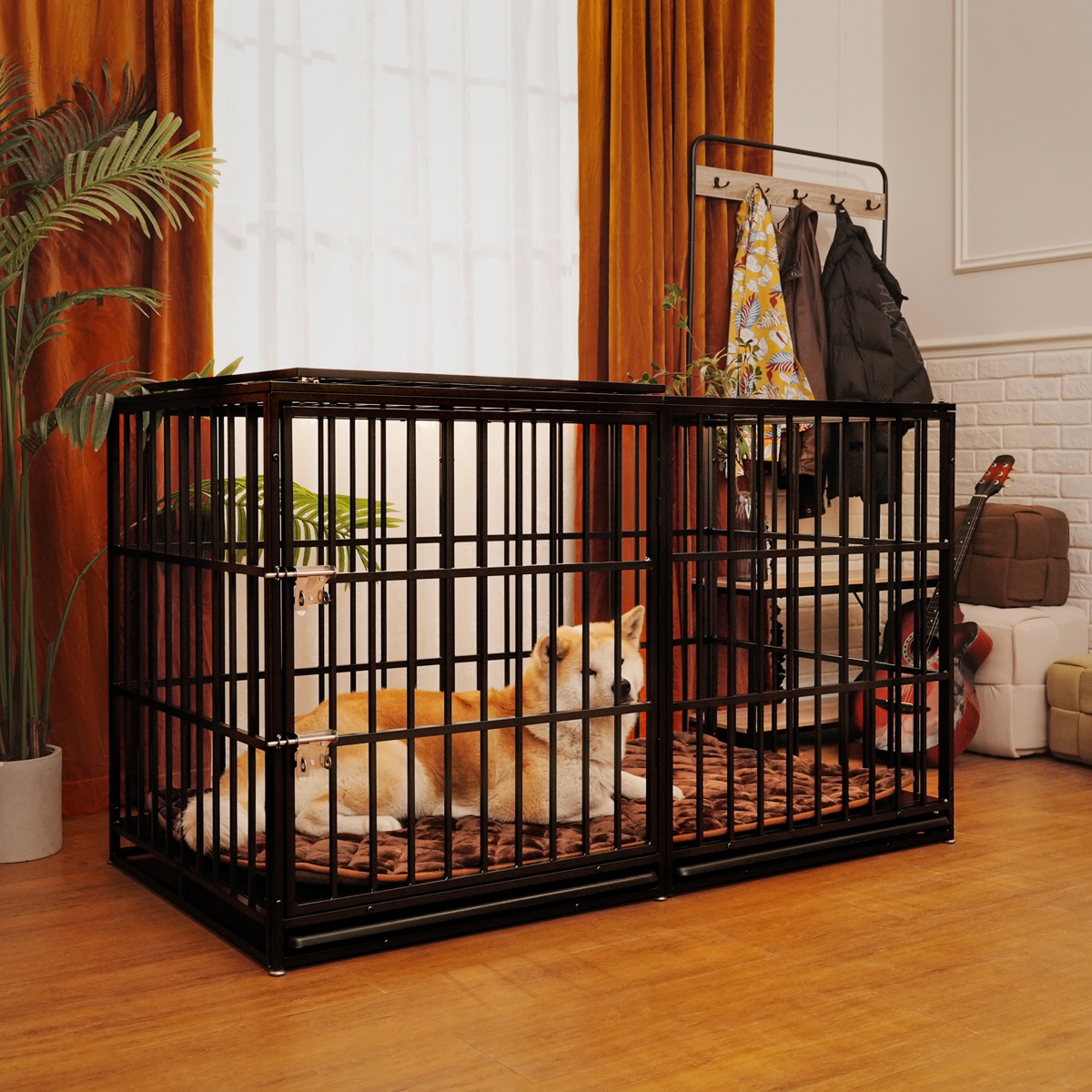

Photos from current listings. Actual item, color, and included accessories may vary.
Strong Dog Cage Buying Guide
Shoppers hunting a 'strong dog cage' usually need to contain a power chewer or a large breed without the crate failing at welds, latches, or door hinges. The decisive factors are steel gauge, bar spacing, weld type, and latch design—not the marketing word 'heavy-duty.' Most failures trace to thin 18–20 gauge wire, spot welds that pop under load, or a single slide latch a determined dog can nose open.
Key takeaways
- Steel gauge drives strength: 20-gauge wire flexes and bends under a 60+ lb dog; 16–18 gauge with reinforced corners holds up to determined chewers.
- Fully welded joints (MIG/TIG) outperform spot-welded or crimped panels, which are the first failure point on budget 'heavy-duty' crates.
- Bar spacing must be 1.5 inches or less for small breeds and 2 inches or less for large breeds to prevent jaw/leg entrapment.
At a glance
- Category
- Pet Crates, Kennels & Playpens
- Last updated
- Nov 28, 2026
Current offers
Highlights
- Steel gauge drives strength: 20-gauge wire flexes and bends under a 60+ lb dog; 16–18 gauge with reinforced corners holds up to determined chewers.
- Fully welded joints (MIG/TIG) outperform spot-welded or crimped panels, which are the first failure point on budget 'heavy-duty' crates.
- Bar spacing must be 1.5 inches or less for small breeds and 2 inches or less for large breeds to prevent jaw/leg entrapment.
- Escape-proof latches require two-point locking (slide bolt plus safety clip) because single slide latches can be nosed or pawed open.
Best use cases
- Best fit: large-breed power chewers (Shepherds, Malinois, Pit mixes) in a 16-gauge fully welded crate with dual slide-bolt latches and 2-inch bar spacing.
- Best fit: indoor apartment containment for medium dogs—choose a 36–42 inch crate with 18-gauge wire and a removable divider for house training.
- Wrong fit: outdoor or yard containment in a wire crate; use a welded kennel run with a concrete anchor instead—wire crates rust and tip under jumping.
- Skip: 'heavy-duty' listings under 1-inch bar diameter or with plastic corner connectors—these are display crates, not containment for strong dogs.
Buying tips
- Check the gauge: 16-gauge is the minimum for dogs over 50 lb; 18-gauge suits 25–50 lb; 20-gauge is only for small or calm breeds.
- Prioritize fully welded frames over spot-welded panels; look for weld beads at every joint and no crimped or riveted connections.
- Size by interior height: dog must stand without crouching and turn around—add 4 inches to shoulder height and 6 inches to body length.
- Avoid single-latch doors; choose crates with two slide bolts plus safety clips, and confirm the door swings inward under pressure.
Specs
| Steel Gauge | 16-20 gauge wire (16 = heavy-duty) |
|---|---|
| Weld Type | Fully welded vs spot-welded |
| Bar Spacing | 1.5-2 in (breed-dependent) |
| Latch Type | Dual slide-bolt + safety clip |
Related searches
What to check before buying
- Measure your dog standing (height to head, length nose-to-tail base) and add 4–6 inches before selecting crate size.
- Confirm bar spacing: 1.5 inches or less for toy/small breeds, 2 inches or less for medium and large breeds.
- Check floor protection: crates over 50 lb need rubber feet or a tray to avoid scratching hard floors and to prevent sliding.
- Verify assembly hardware: welded crates ship assembled or with bolts; avoid tool-free snap-together frames for strong dogs.
FAQ
Data sources: eBay / Amazon listings and product attribute feeds. Updated Nov 28, 2026.
Some links on this page are affiliate links. If you buy after clicking one, we may earn a commission at no extra cost to you. This does not change which products appear here or their order. Affiliate disclosure.