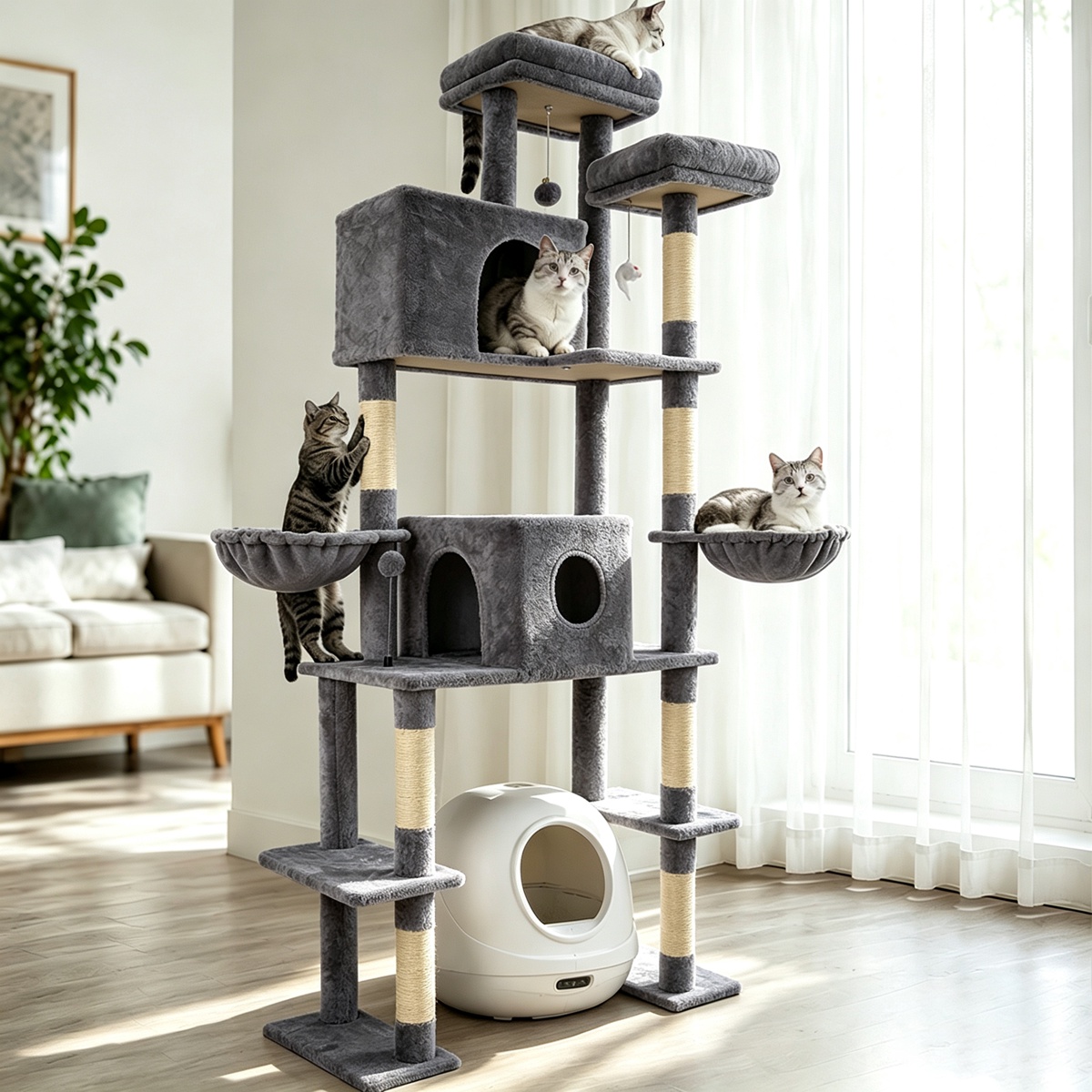

Photos from current listings. Actual item, color, and included accessories may vary.
Cat Tree With Litter Box Buying Guide
A cat tree with a litter box integrates vertical climbing, scratching, resting, and elimination into one footprint-saving unit, typically using a divided base or lower enclosure to house a standard litter pan. The core trade-off is structural stability versus enclosure accessibility: taller towers with a dedicated litter cabinet need a wide, weighted base and rigid particleboard or plywood panels, while flimsy MDF-and-cardboard builds wobble and trap odors. The decision rule is simple: buy only models with a base footprint at least as wide as the tower height divided by three, a removable or hooded litter tray, and full sisal-wrapped posts—skip any unit that hides the litter box behind a fixed panel or relies on a base narrower than the top perch.
Key takeaways
- Height-to-base ratio determines tip resistance: a 78.7 in tower needs a base at least 26 in wide in both dimensions; narrower split bases flex under multi-cat jumping loads.
- Litter enclosure design splits into open tray recesses, hooded cabinets, and integrated covered boxes—hooded cabinets control odor but require a removable lid or front door for daily scooping.
- Sisal rope grade matters: 4–6 mm natural sisal wrapped on full-height posts outlasts glued-on carpet strips or thin 3 mm twine that shreds within months.
At a glance
- Category
- Pet Beds & Cat Trees
- Last updated
- Nov 28, 2026
Current offers
Highlights
- Height-to-base ratio determines tip resistance: a 78.7 in tower needs a base at least 26 in wide in both dimensions; narrower split bases flex under multi-cat jumping loads.
- Litter enclosure design splits into open tray recesses, hooded cabinets, and integrated covered boxes—hooded cabinets control odor but require a removable lid or front door for daily scooping.
- Sisal rope grade matters: 4–6 mm natural sisal wrapped on full-height posts outlasts glued-on carpet strips or thin 3 mm twine that shreds within months.
- Platform and condo materials range from 9–12 mm particleboard (entry tier) to 15–18 mm plywood or engineered wood (durable tier); thicker panels resist screw pull-out at connector joints under repeated jumping.
Best use cases
- Best fit: multi-cat households with limited floor space—choose a tower with a wide split base that accepts a standard 18–20 in litter pan under the first platform and at least two condos for separation.
- Best fit: odor-sensitive homes—pick a hooded litter cabinet model with a charcoal filter slot and a front access door rather than an open tray recess.
- Wrong fit: senior or arthritic cats—skip tall 70+ in towers with high-entry litter cabinets; choose a low-profile unit with a step-in tray and ramps.
- Wrong fit: small apartments with narrow hallways—avoid models whose base exceeds 30 in in either dimension; a wall-anchored tower with a 24 in base is the practical limit.
Buying tips
- Measure your litter pan first: standard open pans run 18–20 in long, 14–16 in wide, and 5–7 in high; the enclosure must add at least 1 in clearance on all sides for scooping.
- Stability rule: base width should be at least one-third of total height; a 78.7 in tower requires a base of roughly 26 in, and wall-anchor straps are mandatory above 60 in.
- Check post attachment: through-bolts or metal brackets at platform joints outperform wood screws into particleboard, which strip under repeated 15–20 lb cat landings.
- Prefer removable litter trays or slide-out cabinets over fixed recesses—fixed enclosures make full litter changes and disinfecting impractical.
Specs
| Height-to-Base Ratio | Base >= 1/3 of height |
|---|---|
| Litter Enclosure Type | Open recess / hooded cabinet / tray |
| Scratching Post Material | 4-6 mm natural sisal rope |
| Panel Build | 9-12 mm particleboard vs 15-18 mm plywood |
Related searches
What to check before buying
- Room footprint: confirm the assembled base dimensions plus 2 in clearance on each side fit your intended corner, and that the tower height clears ceiling fans and door swings.
- Litter pan compatibility: verify the enclosure interior dimensions accommodate your pan with 1 in side clearance and 2 in headroom above the pan rim.
- Wall anchoring: check that the unit includes anchor straps or that the top platform sits within reach of a stud or masonry wall for a safety strap.
- Floor and climate: carpeted platforms shed fibers on hard floors; high-humidity rooms degrade particleboard—choose sealed plywood or engineered wood in damp climates.
FAQ
Data sources: eBay / Amazon listings and product attribute feeds. Updated Nov 28, 2026.
Some links on this page are affiliate links. If you buy after clicking one, we may earn a commission at no extra cost to you. This does not change which products appear here or their order. Affiliate disclosure.